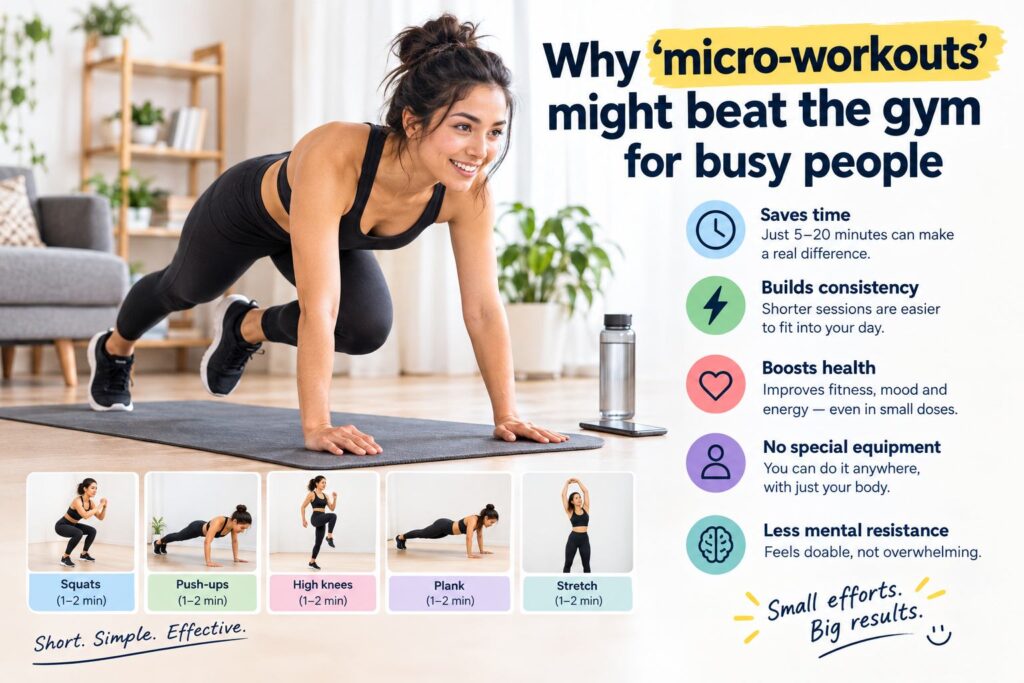
The traditional fitness model — a single, dedicated gym session lasting thirty to sixty minutes — has long been treated as the gold standard for meaningful exercise, with shorter, scattered activity throughout the day generally dismissed as a poor substitute. A growing body of research is complicating that assumption, and for people who genuinely struggle to protect a dedicated gym block, the findings are worth taking seriously.
What the research actually shows about short bursts
Several studies over recent years have specifically examined the health impact of what researchers call exercise snacking — brief bursts of vigorous activity, often just a few minutes long, scattered across a day rather than consolidated into one session. The findings have been genuinely surprising to some researchers: several studies found comparable or, in specific metrics, even superior improvements in markers like blood sugar regulation and cardiovascular fitness compared to a single continuous session of equivalent total duration.
One frequently cited line of research specifically examined brief stair-climbing bursts — as short as twenty seconds, repeated several times throughout a day — and found measurable fitness improvements over several weeks comparable to more traditional, longer continuous exercise sessions in previously sedentary participants. Researchers involved were careful to note this doesn’t mean short bursts are universally superior to longer sessions for every fitness goal, but that for baseline cardiovascular and metabolic health specifically, the total accumulated activity appears to matter more than whether it’s consolidated or scattered.
Why scattered activity might suit busy schedules better
Beyond the direct physiological findings, researchers pointed to an adherence advantage that may matter as much as the physiological data itself. A single thirty-minute gym session requires a specific, protected block of time, plus often travel time, that many people with unpredictable or heavily scheduled days struggle to consistently protect, leading to frequent missed sessions and, eventually, an abandoned exercise habit entirely.
Micro-workouts, by contrast, can be inserted into gaps that already exist within an otherwise busy day — a few minutes between meetings, a flight of stairs instead of a lift, a brisk walk during a phone call — without requiring any dedicated, protected time block at all. Several researchers specifically framed this adherence advantage as potentially more significant for long-term health outcomes than any marginal difference in per-minute physiological benefit between the two approaches, since a consistently maintained micro-workout habit will outperform a superior but frequently abandoned traditional gym routine over any meaningful timeframe.
Where a traditional gym session still has a clear edge
Researchers were careful to note real limits to the micro-workout approach, particularly for specific goals like building substantial muscle mass, where progressive overload with meaningfully heavy resistance — genuinely difficult to replicate in brief, scattered bursts without access to proper equipment throughout the day — remains more effectively achieved through a dedicated, focused strength session. For anyone with a specific strength or hypertrophy goal, a traditional structured session retains clear advantages current micro-workout research hasn’t matched.
The most sensible practical framing, according to the researchers consulted, isn’t choosing exclusively between the two approaches but recognising that micro-workouts offer genuine, evidence-backed benefit specifically for baseline cardiovascular and metabolic health during periods when a traditional gym routine isn’t realistically sustainable, while a structured session remains valuable for anyone with more specific strength or performance goals and the schedule flexibility to protect time for it.
For the specific audience this research is most relevant to — people who’ve effectively stopped exercising altogether because they can’t consistently protect a traditional gym block — the message from researchers was clear and somewhat reassuring: scattered, brief activity throughout a busy day isn’t a poor consolation compared to a proper workout, but a genuinely evidence-backed approach in its own right, and very likely a better starting point than continuing to skip exercise entirely while waiting for a schedule that allows for a traditional gym routine.
Practical ways people are fitting micro-workouts into a real day
Researchers and the people they’ve studied described a range of practical approaches to actually implementing micro-workouts within an ordinary working day, from simple bodyweight squats done during a kettle boiling, to brief resistance-band sessions kept at a desk for genuinely idle moments between tasks, to the previously mentioned stair-climbing approach for anyone working in a multi-storey building. The specific activity mattered less than the consistency of returning to it multiple times across a day rather than treating any single burst as sufficient on its own.
Several people who’d adopted a micro-workout approach specifically after previously struggling to maintain any consistent exercise habit described an unexpected additional benefit: the lower psychological barrier to starting a two-minute activity, compared to committing to a full session, made the habit considerably easier to sustain through busy or low-motivation periods that had previously derailed more traditional exercise attempts entirely for weeks or months at a time.
What researchers are still trying to figure out
Researchers were candid that this remains a genuinely active area of study, with several open questions still unresolved — including exactly how the specific timing and spacing of micro-workouts throughout a day affects their cumulative benefit, and whether there’s a meaningful ceiling beyond which additional scattered bursts stop adding proportional benefit, similar to patterns already observed in more traditional step-count research.
Despite these open questions, researchers felt confident enough in the current evidence to recommend micro-workouts as a legitimate strategy today, rather than waiting for a fully resolved picture before offering practical guidance to people currently exercising far less than they’d like simply because a traditional gym routine doesn’t fit their actual daily schedule. The consistent message across every researcher consulted was that some consistent, scattered movement throughout a busy day beats no movement at all, and that waiting for the perfect, uninterrupted gym window before starting to exercise again is, for many people, a genuine barrier worth abandoning in favour of what’s actually achievable today. Perfect, in this case, really is the enemy of good. For anyone who has quietly given up on exercise altogether, that reframing alone may be the more valuable takeaway than any specific study result.