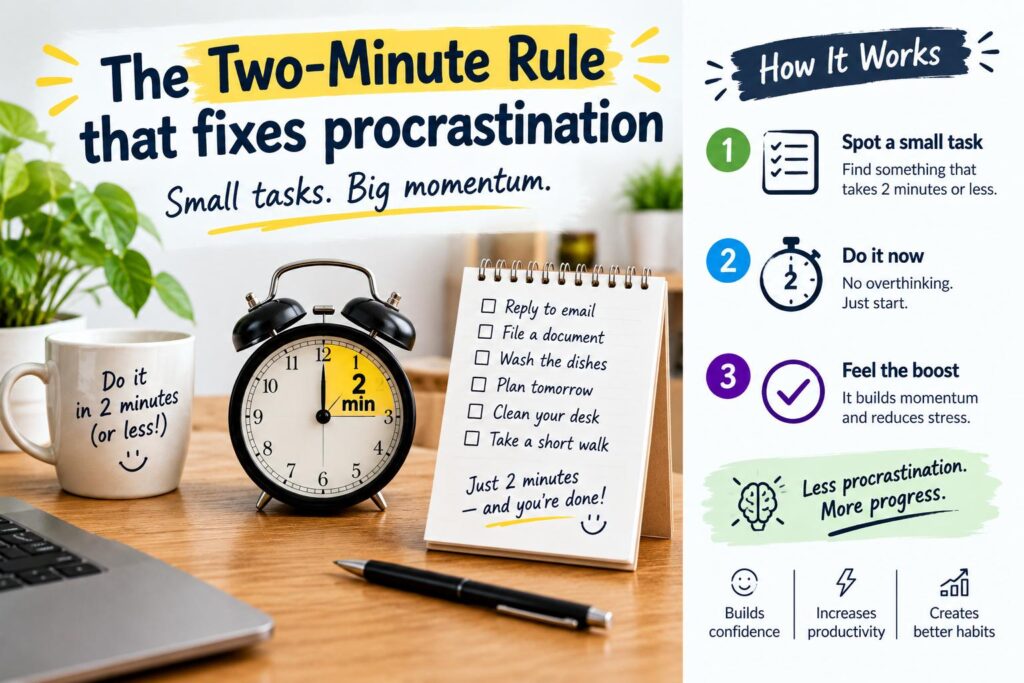
Productivity advice tends to arrive in two flavours: elaborate systems requiring dedicated apps and weekly review sessions, or single, almost suspiciously simple rules that seem too basic to genuinely change behaviour. The two-minute rule — if a task takes under two minutes, do it immediately rather than adding it to a list — belongs firmly in the second category, and according to the behavioural researchers we consulted, its simplicity is precisely why it actually works.
Why small tasks cause disproportionate procrastination
The rule addresses a specific, well-documented pattern in how people handle small obligations: tasks that would take under two minutes to simply complete instead get added to a mental or written list, where they then sit, generating low-grade background stress disproportionate to their actual size, sometimes for days or weeks, before finally being done — often taking barely longer than they would have taken if handled immediately.
Researchers describe this as a mismatch between a task’s actual cost and its psychological weight once deferred. A two-minute email reply feels trivial in isolation, but once it joins a list of a dozen similarly small deferred tasks, the cumulative sense of unfinished obligations can produce genuine anxiety disproportionate to the total time any of them would actually take to complete, a phenomenon closely related to what psychologists call the Zeigarnik effect — the tendency for uncompleted tasks to occupy more mental space than completed ones.
How the rule breaks the pattern
By intercepting genuinely small tasks before they ever join a list, the two-minute rule prevents this accumulation entirely. The task gets done, the mental space it would have occupied never opens up, and — critically, according to several people who’ve maintained the habit for years — the practice tends to build a broader sense of momentum and capability that makes larger, genuinely list-worthy tasks feel less daunting by comparison.
The rule’s discipline lies specifically in the two-minute threshold itself, which needs to be honestly assessed rather than optimistically stretched to cover tasks that would actually take considerably longer. Several productivity researchers noted that the most common way people undermine the rule is applying it to tasks they wish were two minutes rather than tasks that genuinely are, which reintroduces exactly the interruption and task-switching cost the rule is designed to avoid for larger work.
Where the rule needs a boundary
Applied without any boundary, the two-minute rule can become its own form of procrastination — using a stream of genuinely small tasks as a way to feel productive while avoiding a larger, more demanding piece of work that actually needs focused attention. Researchers specifically recommend pairing the rule with a boundary: apply it freely during natural breaks between larger tasks, but resist reaching for small two-minute tasks as an escape hatch in the middle of focused work on something bigger.
The most effective use case researchers described was applying the rule specifically at natural transition points — right after finishing a meeting, first thing in the morning before diving into focused work, or during the small gaps between larger tasks that would otherwise be filled with idle phone scrolling. Used this way, the rule cleans up small obligations during time that would likely be unproductive anyway, rather than displacing genuinely important, larger work.
What makes the two-minute rule notably more durable than more elaborate productivity systems, according to everyone we spoke with, is precisely its lack of infrastructure — no app to maintain, no weekly review to schedule, nothing to fall behind on and then abandon. It’s simply a decision rule applied in the moment a small task presents itself, which may be exactly why, unlike so many more elaborate systems that get abandoned within weeks, this one tends to actually stick.
Combining it with other habits, without overcomplicating it
Several productivity researchers noted that the rule pairs particularly well with existing task-management systems rather than replacing them entirely — it functions as a filter applied before anything gets added to a list in the first place, rather than a competing system that needs to be reconciled with whatever larger project-tracking method someone already uses. This compatibility is part of why it’s been adopted so widely across otherwise very different personal productivity approaches, from minimal paper-list users to people running elaborate digital task-management setups.
The rule also extends naturally to email and messaging specifically, a context where researchers noted it’s particularly effective given how disproportionately small email replies tend to accumulate into an intimidating, anxiety-inducing backlog. Applying the two-minute threshold specifically during a dedicated, time-boxed inbox check — rather than throughout the day, which researchers cautioned can fragment focus on other work — was the most commonly recommended specific application.
What the research says about why it feels so satisfying
Beyond the practical time-management logic, researchers pointed to a psychological component worth understanding: completing even very small tasks triggers a genuine, measurable sense of accomplishment tied to the brain’s reward pathways, similar in kind if smaller in scale to the satisfaction of completing any goal-directed action. Stacking several of these small completions in a short period, as the two-minute rule naturally encourages, can produce a cumulative sense of momentum that several researchers described as genuinely motivating for tackling subsequent, larger tasks.
This helps explain why so many people who adopt the rule describe not just getting more small tasks done, but feeling generally more capable and less overwhelmed afterward — the rule’s benefit, researchers suggested, may be as much about this psychological momentum effect as about the literal minutes saved by handling small tasks immediately rather than deferring them. For anyone who’s tried and abandoned more elaborate productivity systems in the past, researchers suggested this single rule is worth trying precisely because failure is low-cost — there’s no system to fall behind on, just a habit to notice and gradually build. Its simplicity is, in the end, exactly the point. Anyone looking for a genuine, low-risk entry point into better personal productivity could do worse than starting here, today, with whatever small task is currently sitting unfinished on a list.