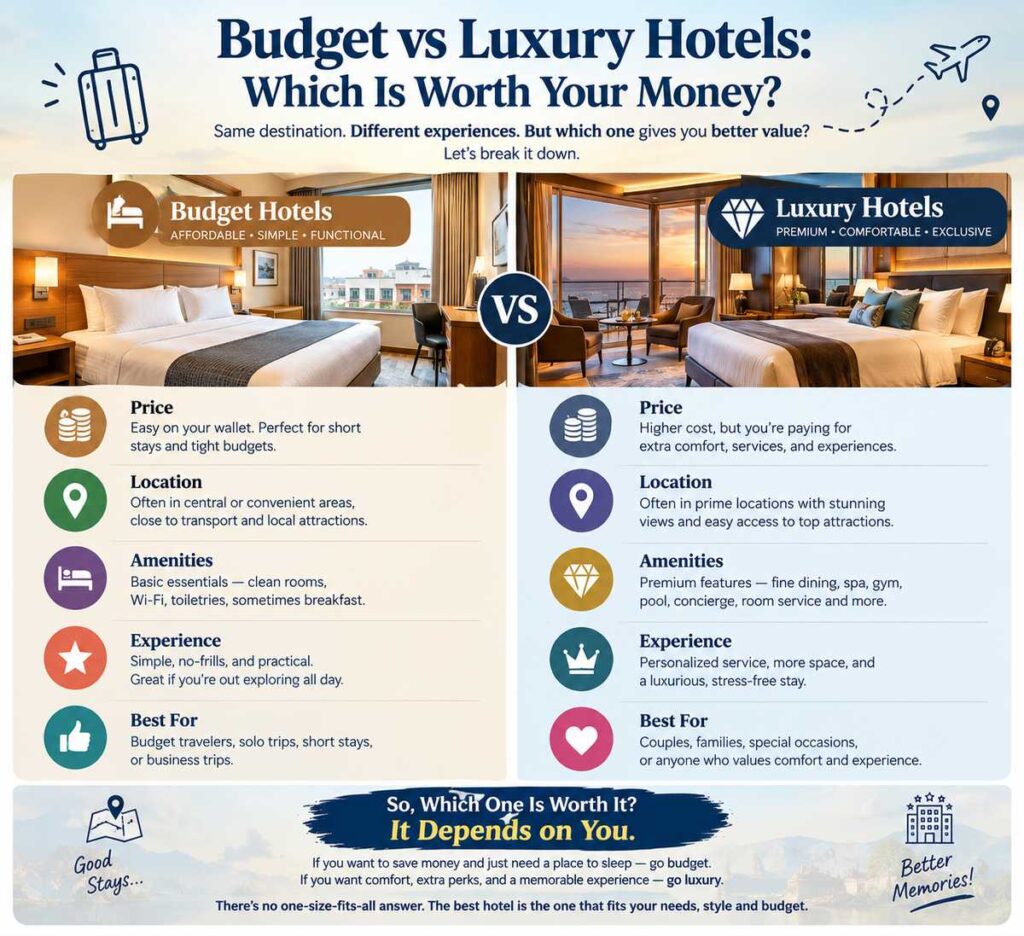
Every traveller eventually faces the same question: should you spend less and keep your stay simple, or pay more for comfort, service and experience? Some people feel that a hotel is just a place to sleep, so why pay extra? Others believe the right hotel can be the highlight of a journey. The truth is that neither answer is universally correct. The right choice depends on your purpose, your schedule, your travel companions and your budget. This detailed guide to budget vs luxury hotels will help you understand the real differences, compare value fairly and decide which type of stay suits your next trip.
We will look at what you typically get in each category, how they compare on comfort, service, food, location, privacy and price, when each option makes sense, why mid-range stays are often the smartest compromise, and how to enjoy luxury without overspending. By the end, you will have a practical framework for making confident decisions.
What Do “Budget” and “Luxury” Actually Mean?
Hotel categories are not standardised worldwide, and star ratings vary between countries and platforms. As a general guide:
Budget hotels are affordable properties that offer basic, clean accommodation. They may include guesthouses, business hotels, hostels, homestays and simple lodges. The focus is on the essentials: a bed, a bathroom, a lock and sometimes Wi-Fi or breakfast.
Mid-range hotels offer more comfort and facilities than budget properties, such as better furnishings, on-site restaurants, room service and decent service, without the premium price of top-tier hotels.
Luxury hotels are high-end properties that focus on exceptional comfort, service and experience. They often feature spacious rooms, premium bedding, multiple restaurants, spas, pools, concierge services and elegant design.
Price alone does not guarantee quality. A carefully run budget hotel can beat a poorly managed expensive one. That is why reviews, photos and details always matter.
What You Usually Get With Budget Hotels
Budget stays have several advantages, especially for travellers who spend most of their time outside.
- Lower nightly rates: The obvious benefit, leaving more money for food, activities and shopping.
- Basic but clean rooms: Simple furniture, a comfortable bed and an attached bathroom in most cases.
- Practical locations: Many budget hotels sit near railway stations, bus stands, airports or busy markets.
- Simple facilities: Wi-Fi, air-conditioning or fan, television and sometimes complimentary breakfast.
- Flexibility: Easy to book at short notice and often more flexible with policies.
- Local flavour: Homestays and guesthouses can offer personal touches and genuine hospitality.
Possible drawbacks:
- Smaller rooms with limited space for luggage
- Thinner walls and more noise
- Limited or no room service
- Older furnishings and fewer amenities
- Inconsistent quality between properties
- Fewer on-site dining options
What You Usually Get With Luxury Hotels
Luxury hotels are built around comfort, privacy and attentive service.
- Spacious, well-designed rooms: Better beds, quality linens, large bathrooms and thoughtful decor.
- Premium services: Concierge assistance, valet, butler service in some properties, 24-hour room service and personalised recommendations.
- Fine dining: Multiple restaurants, bars and quality breakfast spreads.
- Wellness and leisure: Spa, gym, swimming pool, yoga sessions and gardens.
- Better soundproofing and privacy: Quieter rooms and less disturbance.
- Stronger security: Controlled entry, trained staff and safe surroundings.
- Special touches: Welcome drinks, turndown service, curated experiences and beautiful settings.
Possible drawbacks:
- Much higher price per night
- Extra charges for food, spa and activities
- You may pay for facilities you rarely use
- Formal atmosphere that some travellers find less relaxed
- Sometimes located away from local life, particularly resorts
Budget vs Luxury Hotels: Head-to-Head Comparison
Comfort
Luxury hotels invest in premium mattresses, pillows, temperature control and room layout, all of which improve sleep and relaxation. Budget hotels provide clean and functional comfort, which is enough for many travellers but may feel limited after a long or tiring trip.
Service
Luxury properties usually have larger staff teams, which means faster responses and more personalised attention. Budget hotels operate with smaller teams and simpler procedures, so service can be friendly but basic.
Food and Dining
A luxury hotel may offer several restaurants with high-quality menus, while a budget hotel might offer a simple breakfast or none at all. However, budget travellers can explore local eateries and street food, often at better prices and with more authentic flavour.
Location
Both categories can be well located. Many budget hotels are surprisingly central, while some luxury resorts are deliberately secluded for peace and views. Check the map instead of assuming.
Privacy and Noise
Luxury hotels often have better soundproofing and more private spaces. Budget hotels near busy roads may be noisier.
Facilities
Luxury properties include pools, spas, gyms and lounges. Budget hotels usually keep to essentials. The key question is whether you will actually use the extras.
Safety and Reliability
Reputable hotels in both categories can be safe, but luxury hotels typically maintain stricter security and standards. For budget stays, it is wise to read recent reviews and choose well-rated properties.
Price
Luxury stays cost significantly more per night, but promotions, package deals and off-season rates can narrow the gap. Budget hotels help you stretch your trip length or spend on experiences.
When a Budget Hotel Is the Smart Choice
Choose a budget hotel if:
- You will spend most of the day outside. If you are sightseeing from morning to night, you may only need a clean place to sleep.
- You are on a long trip. Saving on accommodation makes extended travel more affordable.
- You are travelling solo or backpacking. Hostels and simple lodges are practical and social.
- You prefer spending on experiences. Use your money for tours, food, adventure sports or shopping.
- It is a short transit stay. For an overnight layover, a comfortable basic room is enough.
- You are travelling frequently for work. Business travellers may prefer efficient, affordable stays.
- You travel in a group. Splitting rooms in budget hotels can reduce the per-person cost.
When a Luxury Hotel Is Worth It
Choose a luxury hotel if:
- The stay is part of the experience. For honeymoons, anniversaries and milestone celebrations, an exceptional hotel adds to the memory.
- You want relaxation. If your goal is to rest, enjoy the spa, swim and dine on-site, a resort makes sense.
- You travel with elderly parents or young children. Extra comfort, service and safety can make travel smoother.
- You value privacy and quiet. Luxury hotels provide a calm environment.
- You have a demanding schedule. After long workdays or a tiring journey, a comfortable room helps you recover.
- You will use the facilities. Pools, spas and restaurants deliver value only if you use them.
- You are attending a special event. Wedding guests or conference attendees may benefit from convenience and comfort.
The Smart Middle: Mid-Range and Boutique Hotels
Often the best value lies between the extremes. Mid-range and boutique hotels offer a strong balance of comfort, character and cost.
Advantages:
- Cleaner, newer and more comfortable rooms than most budget options
- Good service without a luxury price tag
- Interesting design and local character in boutique properties
- Useful amenities like breakfast, Wi-Fi and a restaurant
- Frequently excellent locations
If you are unsure, start your search in the mid-range category and adjust upward or downward based on reviews and available offers.
How to Decide: A Simple Framework
Answer these questions to guide your decision:
- How much time will I spend in the hotel? More time means more value from comfort and facilities.
- What is my travel purpose? Adventure, relaxation, business or celebration?
- Who am I travelling with? Comfort needs differ for families, elders and friends.
- What is my overall budget? Consider transport, food, activities and shopping as well.
- What would I regret skipping? A great room or a great experience elsewhere?
- Will I use the extras? If not, do not pay for them.
A helpful guideline is to allocate your budget based on what enhances your trip most. Some travellers prefer to save on the room and splurge on food and activities. Others prefer the opposite. Neither is wrong.
Hidden Costs to Consider
Price comparison should include all costs, not just the room rate.
In luxury hotels:
- Expensive restaurant meals and drinks
- Spa treatments and activities
- Airport transfers and parking
- Resort or service fees
- Higher taxes on premium rates
In budget hotels:
- Extra transport costs if the location is far from attractions
- Paying separately for breakfast or laundry
- Lack of included facilities such as Wi-Fi or hot water
- Extra charges for extra beds or late checkouts
- Time lost in commuting
Calculate the full cost of your stay to see the true difference.
How to Enjoy Luxury Without Overspending
You do not always need a top-tier budget to enjoy premium experiences.
- Travel in the off-season. Luxury hotels often reduce prices when demand is lower.
- Look for package deals. Bundles that include breakfast, dinner, spa credit or activities can offer good value.
- Choose weekdays over weekends. Rates are commonly lower.
- Use loyalty points. Frequent travellers can earn free nights or upgrades.
- Book directly for perks. Some hotels offer complimentary breakfast or late checkout to direct customers.
- Stay fewer nights. Consider spending one or two nights in a luxury hotel and the rest in mid-range stays.
- Visit without staying. Enjoy afternoon tea, brunch or the spa at a luxury hotel while staying elsewhere.
- Politely ask for an upgrade at check-in. It does not always work, but it costs nothing to ask, especially during quiet periods or special occasions.
- Watch for card and bank offers. Many payment cards provide discounts on hotel bookings.
How to Get the Best From a Budget Stay
Budget hotels can be pleasant when you choose carefully.
- Read recent reviews about cleanliness and safety.
- Check that the location is convenient and safe at night.
- Look for properties with breakfast included.
- Confirm that hot water, air-conditioning and Wi-Fi are working.
- Carry your own essentials such as a small towel, toiletries and a power strip.
- Choose higher floors or rooms away from the road to reduce noise.
- Use earplugs and an eye mask if needed.
- Keep valuables secure.
A small amount of preparation can make a simple stay comfortable.
Common Mistakes When Choosing Between Budget and Luxury
- Assuming price equals quality. Always verify with reviews and photos.
- Ignoring location. A luxurious hotel far from your plans can be inconvenient.
- Paying for facilities you will not use. Be honest about your schedule.
- Choosing the cheapest option without checking hygiene and safety. Saving money should not compromise wellbeing.
- Overlooking total cost. Add up transport, meals and fees.
- Booking non-refundable rates without certainty. Flexibility is valuable if plans might change.
- Forgetting the purpose of the trip. Align the hotel with your goals.
Sample Scenarios
A weekend city break with friends: A stylish mid-range hotel in a central location gives comfort and convenience, leaving money for dining and nightlife.
A honeymoon: A boutique resort or luxury hotel with a private setting, good food and a beautiful room adds romance and relaxation.
A backpacking trip across several cities: Hostels and budget guesthouses stretch your budget across more destinations.
A family holiday with young children: A mid-range or upper-mid-range hotel with a pool, spacious rooms and breakfast is often ideal.
A business trip: A comfortable business hotel near your meetings, with reliable Wi-Fi and a good desk, is usually enough.
A trip with elderly parents: Comfortable rooms, lifts, easy access, quiet surroundings and good food make a moderately priced or premium hotel worthwhile.
Frequently Asked Questions
Are luxury hotels always better than budget hotels?
Not always. They generally offer more comfort and service, but the value depends on whether you use those benefits and whether the specific hotel is well managed.
Is a cheap hotel safe?
Many are, but you should check recent reviews, the neighbourhood and security features such as locks and reception service before booking.
How much should I spend on accommodation?
There is no fixed rule. Many travellers set a portion of their overall trip budget for accommodation and adjust depending on how much time they will spend at the hotel.
Can I get luxury hotel quality at a lower price?
Yes. Off-season travel, package deals, loyalty programmes and mid-week stays can reduce costs significantly.
What is the best option for a short trip?
If you will be out most of the time, a clean, well-located budget or mid-range hotel is often enough. If the trip is about rest, a more comfortable hotel may be worth it.
Do star ratings guarantee quality?
No. Star ratings are only a guide. Recent guest reviews and real photos give a more accurate picture.
Final Thoughts
The debate over budget vs luxury hotels is not about which is universally superior. It is about matching your stay to your goals. A budget hotel can be an excellent, sensible choice when you are exploring all day and want to make your money go further. A luxury hotel can be worth every rupee when rest, celebration or high-quality service is the heart of your trip. And mid-range or boutique hotels often provide the best blend of comfort and value.
Before you book, decide what matters most, calculate the total cost, read recent reviews and think honestly about how you will spend your time. When you choose with purpose, you will not just find a place to sleep. You will find a stay that adds to your journey and gives you real value for your money.