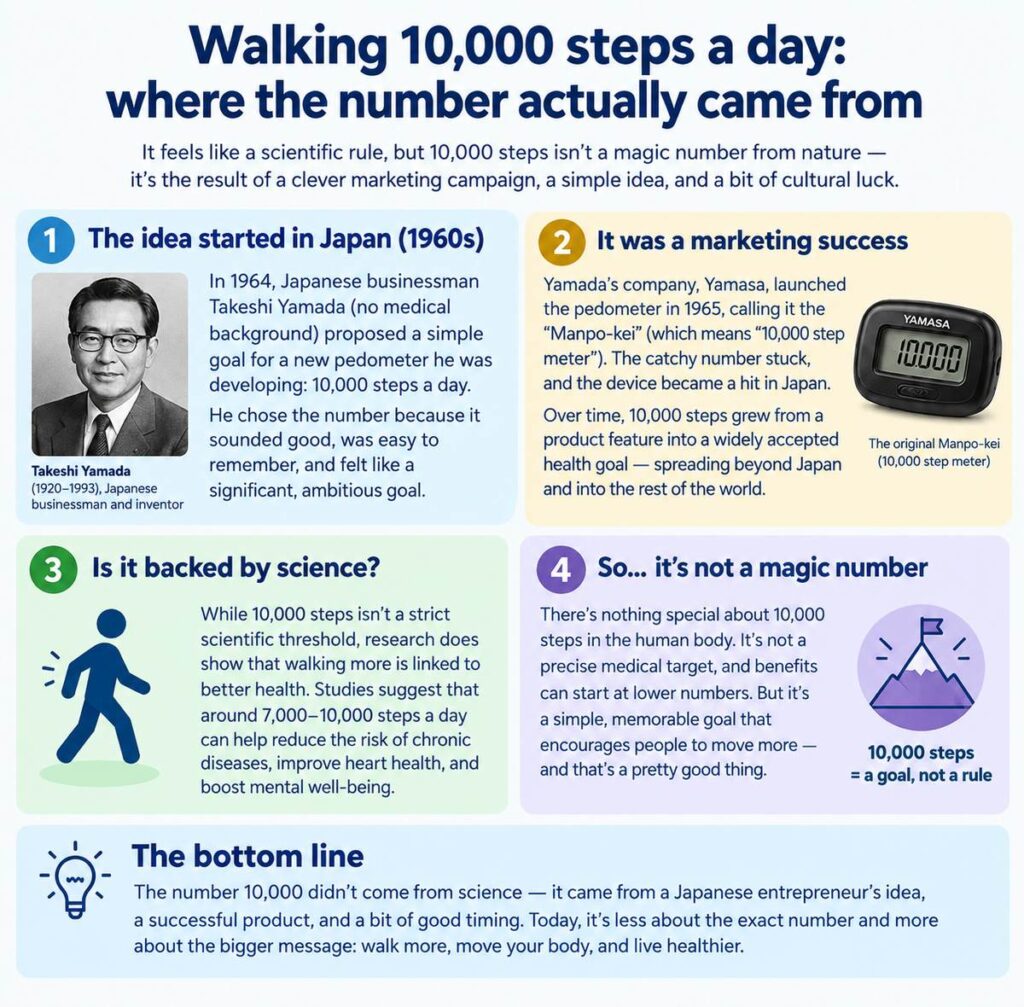
The 10,000-step daily target is one of the most widely recognised health benchmarks in the world, built into the default settings of countless fitness trackers and smartphone apps. It’s also, according to the research we dug into for this piece, not actually based on any specific scientific study establishing 10,000 as an optimal daily step count — its origin is considerably more commercial than most people assume.
The marketing campaign behind the number
The 10,000-step figure traces back to a Japanese pedometer product launched ahead of the 1964 Tokyo Olympics, marketed under a name that translates roughly to ‘10,000-step meter’. According to researchers who’ve traced the figure’s history, the specific number appears to have been chosen largely because the Japanese character for ‘10,000’ resembles a walking figure, making it a memorable, visually appealing marketing choice rather than a number derived from any underlying exercise physiology research at the time.
This marketing-driven origin didn’t stop the figure from becoming deeply embedded in public health messaging over subsequent decades, eventually being adopted internationally as a de facto standard target, well before fitness trackers made step counting a mainstream daily habit, and long before more rigorous research had actually tested whether 10,000 specifically represented any kind of genuinely optimal or evidence-based target for general health outcomes.
What more recent research actually found
Several large-scale studies conducted over the past decade have specifically examined the relationship between daily step count and health outcomes, including mortality risk, and the findings suggest a more nuanced picture than the single round-number target that’s become so culturally embedded. Multiple studies have found that health benefits, particularly reduced mortality risk, show diminishing returns well before reaching 10,000 steps, with meaningful benefit already apparent at considerably lower daily step counts.
One frequently cited large-scale study found that mortality risk reduction benefits began levelling off somewhere in the range of 7,000 to 8,000 steps daily for many population groups studied, with additional steps beyond that range continuing to offer some incremental benefit but at a meaningfully reduced rate compared to the benefit gained by increasing from a more sedentary baseline up to that initial range. This doesn’t mean 10,000 steps is harmful or not worth pursuing, simply that it doesn’t appear to represent a specific threshold below which benefits are absent or above which benefits dramatically accelerate.
What this means for how to actually think about step goals
Researchers in this area generally emphasise that the specific numerical target matters considerably less than the underlying principle of moving from a more sedentary baseline toward greater regular activity, whatever the specific starting point happens to be. For someone currently averaging 3,000 steps daily, a goal of 10,000 may represent a genuinely difficult, discouraging jump, whereas a more incremental target of 6,000 or 7,000 steps may be both more achievable and, according to the research discussed above, capture a meaningful portion of the available health benefit regardless.
This more flexible, individualised framing has increasingly been adopted by health professionals over recent years, moving away from a single universal target toward personalised recommendations based on an individual’s current activity level, age and specific health circumstances. Several researchers specifically noted that this shift matters not just for physiological reasons but for genuine sustainability and motivation — a target that feels achievable is considerably more likely to be maintained consistently than one that feels arbitrary and consistently out of reach.
None of this means 10,000 steps is a bad goal for anyone already comfortably active at that level — it remains a perfectly reasonable target, and continuing to hit it carries no known downside. But for anyone who’s found the figure discouraging or unachievable, the actual research suggests there’s nothing scientifically special about that specific number, and a more modest, personally calibrated target is likely to deliver a meaningful share of the available health benefit while being considerably easier to sustain as a genuine long-term daily habit.
Why walking speed and pattern may matter as much as total count
More recent research has also begun examining factors beyond raw daily step count, including walking speed, or cadence, as a potentially significant independent factor in the health benefits associated with walking. Several studies have found that a faster walking pace was associated with additional health benefit beyond what step count alone predicted, suggesting that a shorter walk taken briskly may offer comparable or even superior benefit to a longer walk taken at a slower, more leisurely pace, at least for certain specific health outcomes studied.
This research is still considered relatively early-stage compared to the more established step-count research discussed above, and researchers have been careful to note that it shouldn’t be read as suggesting step count doesn’t matter at all, simply that pace and intensity appear to be additional, somewhat independent factors worth considering alongside total daily volume rather than a replacement consideration for it entirely.
The practical takeaway for anyone setting a personal goal
For anyone currently using a fitness tracker defaulted to the standard 10,000-step target, the practical suggestion emerging from this body of research isn’t necessarily to abandon that target if it’s already comfortably achievable, but rather to treat the number with considerably less rigidity than its cultural prominence might suggest. Missing the target on a particular day carries no specific meaningful consequence that hitting exactly 10,000 uniquely avoids, and for anyone starting from a more sedentary baseline, a more modest, genuinely achievable target is likely to produce better long-term outcomes than an ambitious but discouraging figure borrowed from a decades-old Japanese marketing campaign that was never actually based on the kind of rigorous research its current cultural authority might imply.
Perhaps the more useful habit to take from this research isn’t a specific number at all, but simply an occasional, honest check-in on overall daily movement relative to one’s own recent baseline, adjusted upward gradually over time rather than measured against a single fixed target inherited from a fifty-year-old marketing campaign. Consistent movement, at whatever specific step count that ends up meaning for a given individual, appears to matter considerably more than hitting any particular round number precisely, however deeply that number has become embedded in popular understanding of what a genuinely active day is supposed to look like.