The biggest barrier to starting yoga isn’t flexibility. It’s the belief that you need a studio, a membership, matching clothes and an hour you don’t have. You need none of those. Yoga for beginners at home requires about two metres of floor, twenty minutes, and a willingness to be bad at it for the first fortnight.
This guide covers a complete beginner sequence, how to do each pose safely, the mistakes almost everyone makes, and a four-week plan to turn it into something you actually keep doing.
What you need before you start
A mat, or a folded blanket. A proper mat helps with grip, but a bedsheet folded four times on a hard floor will do for the first few weeks. Don’t practise on a bed — it’s too soft to balance on.
Clothes you can move in. Anything that doesn’t restrict your hips or ride up when you bend forward.
An empty stomach, or close to it. Two to three hours after a full meal, or first thing in the morning. A glass of water and a banana is fine.
Somewhere you can leave the mat out. If rolling out the mat is a chore, the practice will quietly die. Visible mat, fewer excuses.
The twenty-minute beginner sequence
Move slowly. Breathe through the nose. If a pose hurts sharply, come out of it — mild effort and stretch are fine, sharp pain is not.
1. Sukhasana with breathing — 3 minutes
Sit cross-legged, or on a folded blanket if your knees sit higher than your hips. Rest the hands on the knees, lengthen the spine, and breathe slowly — in for a count of four, out for a count of six. The longer exhale is what settles the nervous system. This isn’t a warm-up you should skip; it’s the part that makes the rest of the practice feel different from exercise.
2. Marjaryasana–Bitilasana (cat–cow) — 2 minutes
Come onto hands and knees, wrists under shoulders, knees under hips. Inhale, drop the belly and lift the chest and tailbone. Exhale, round the spine and tuck the chin. Move with the breath, one movement per breath. This mobilises every segment of the spine and is the best possible first movement after sleep.
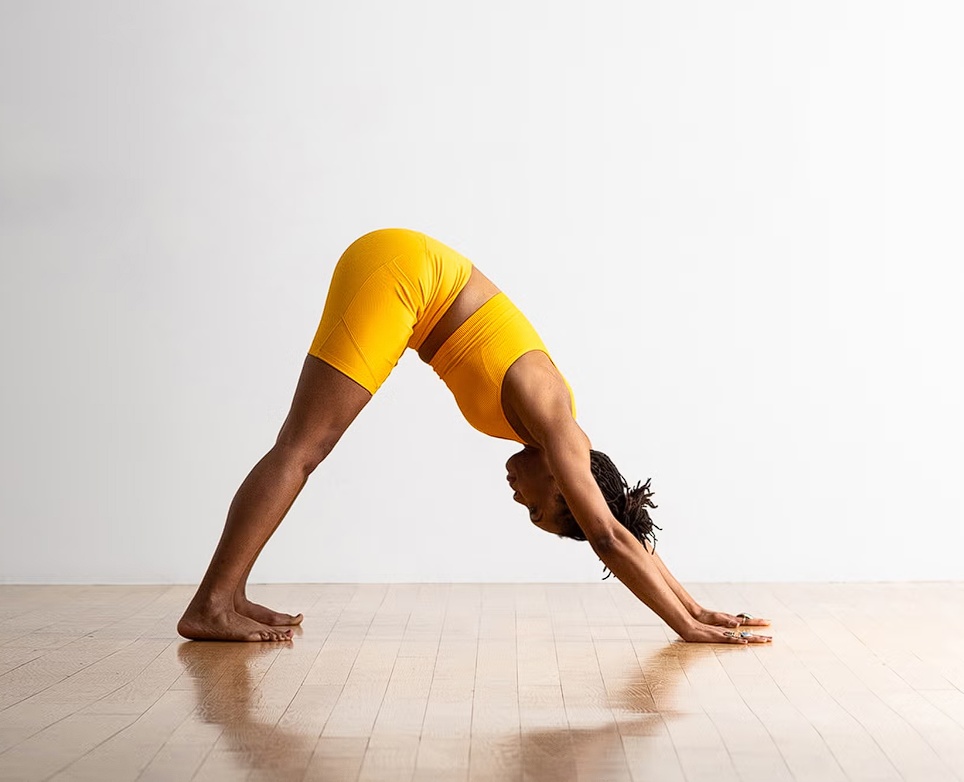
3. Adho Mukha Svanasana (downward-facing dog) — 1 minute
From hands and knees, tuck the toes and lift the hips up and back. Keep the knees generously bent — almost everyone’s hamstrings are too tight to straighten the legs at first, and forcing it rounds the lower back. Press the hands firmly into the floor and lengthen from the wrists to the hips. Pedal the feet gently.
4. Surya Namaskar — 4 rounds, about 5 minutes
The sun salutation links twelve positions into one flowing sequence. As a beginner, move at half speed and take a full breath in each position rather than trying to keep pace with a video. Four rounds is plenty. If four feels like too many, do two well.
5. Virabhadrasana II (warrior II) — 1 minute each side
Step the feet wide apart, turn the right foot out, bend the right knee to roughly ninety degrees, and extend the arms out at shoulder height. Keep the bent knee tracking over the middle toes, not collapsing inward. Look over the front hand. This builds leg strength and hip openness — two things desk work destroys.
6. Trikonasana (triangle) — 1 minute each side
From a wide stance with the front foot turned out, straighten the front leg and hinge sideways over it, lowering one hand to the shin and reaching the other to the ceiling. Don’t chase the floor with the lower hand; keep the chest open and the spine long instead.
7. Balasana (child’s pose) — 1 minute
Kneel, bring the big toes together, widen the knees, and fold forward with arms extended or alongside the body. A genuine rest, and the pose you should return to any time in a practice when you need a break.
8. Setu Bandhasana (bridge) — 1 minute
Lie on your back, knees bent, feet hip-width and close to the hips. Press the feet down and lift the hips. Keep the knees parallel. This counteracts hours of sitting by opening the front of the hips and strengthening the glutes.
9. Supta Matsyendrasana (supine twist) — 1 minute each side
On your back, draw the right knee in and let it cross over to the left, arms out wide, gaze to the right. Let gravity do the work.
10. Savasana — 3 minutes
Lie flat, palms up, eyes closed, and do nothing. This is not optional padding. It’s where the nervous system consolidates everything the practice just did. Skipping savasana is the most common beginner mistake by a wide margin.
Mistakes almost every beginner makes
Holding the breath. When a pose gets difficult, breathing is the first thing to go. If you can’t breathe smoothly in a pose, you’ve gone too deep. Back off until the breath returns.
Comparing yourself to the person in the video. They’ve been practising for a decade. Hip and shoulder anatomy also varies enormously between individuals — some bodies will never achieve certain shapes, and that has nothing to do with effort.
Locking the joints. Hyperextending the knees or elbows puts load on ligaments instead of muscles. Keep a micro-bend.
Practising only when motivated. Ten minutes on a bad day beats forty-five minutes once a fortnight.
Doing too much too soon. Beginners who start with ninety-minute sessions usually stop within three weeks. Twenty minutes is a length you can sustain.
A four-week plan to build the habit
Week 1 — Learn the shapes. Three sessions, twenty minutes each. Don’t worry about depth or flow. Just learn where the limbs go.
Week 2 — Add the breath. Four sessions. Match one breath to each movement in cat–cow and sun salutations. This is when yoga starts feeling different from stretching.
Week 3 — Build consistency. Five sessions, same time each day. Morning is easiest because nothing has had a chance to interfere yet.
Week 4 — Extend slightly. Six sessions, adding two or three minutes. Add a balance pose like Vrksasana (tree) and a longer savasana.
By the end of four weeks, most people notice better sleep, less lower-back stiffness and a shorter fuse between stress and recovery — long before they notice any change in flexibility.
Who should be cautious
Yoga is gentle, but it isn’t universally safe in every form. Check with a doctor first if you have high or uncontrolled blood pressure, glaucoma, recent surgery, a herniated disc, or any joint injury. Avoid inversions and deep backbends during pregnancy unless you’re working with a qualified prenatal teacher. Certain poses are also traditionally avoided during menstruation, though this varies by school of practice and by individual comfort.
If anything produces sharp, shooting or radiating pain, stop. Discomfort in a muscle is normal; pain in a joint or down a limb is not.
Frequently asked questions
Can I learn yoga at home without a teacher?
You can build a safe daily practice at home with basic poses. A few in-person classes early on are worth it for alignment corrections that are hard to self-diagnose, but they aren’t a prerequisite to starting.
What is the best time to do yoga?
Early morning on an empty stomach is traditional and practical, because it’s the time least likely to be hijacked by something else. Evening practice is fine too — just keep it gentler.
How long before I see results?
Better sleep and reduced stiffness often show up within two to three weeks. Visible strength and flexibility changes typically take two to three months of consistent practice.
Do I need to be flexible to start yoga?
No. That’s like saying you need to be clean before a shower. Flexibility is an outcome, not an entry requirement.
How many days a week should a beginner practise?
Three to four days a week is enough to make progress. Daily short practice works better than occasional long ones.
The takeaway
Start with twenty minutes, three times this week. Don’t buy anything yet, don’t watch six comparison videos, and don’t wait for a Monday. Roll out something soft, sit down, breathe for three minutes, and move through the sequence slowly. The habit is built by showing up badly and often, not by starting perfectly.
This article is general wellness information and not medical advice. Consult a doctor or a qualified yoga therapist before starting a new practice if you have an existing health condition or injury.