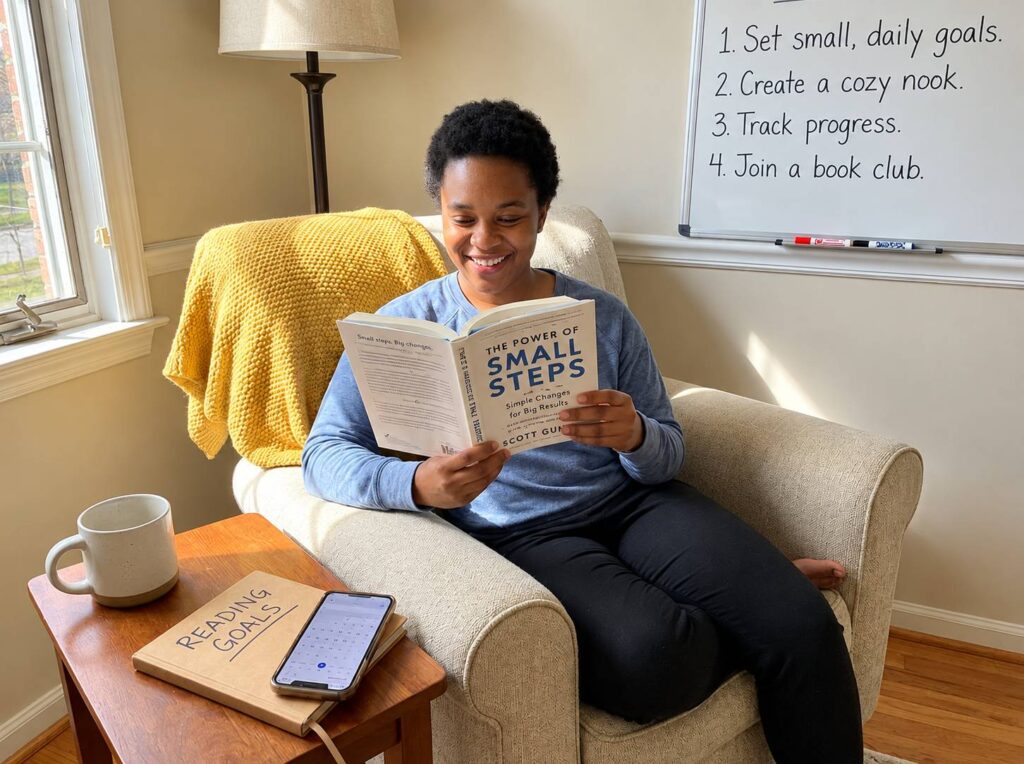
Reading goals are among the most commonly set and most commonly abandoned personal resolutions, typically fading out within the first few weeks of a new year alongside gym memberships and other well-intentioned habits. We spoke with several people who’ve successfully maintained a consistent daily reading habit for years, looking specifically for what actually made the difference between a habit that stuck and the more common pattern of enthusiastic starts followed by quiet abandonment.
Why an ambitious goal usually backfires
The most common mistake, according to nearly everyone we spoke with, was setting an initial goal that was simply too ambitious relative to actual available time and energy — a book a week, or a specific large number of books for the year, set with genuine enthusiasm in January but based more on aspiration than a realistic assessment of daily reading capacity given work, family and other existing commitments.
Several people specifically described a pattern where an ambitious early goal led to reading feeling like an obligation rather than an enjoyable habit within just a few weeks, at which point the entire practice became associated with a vague sense of falling behind rather than pleasure, making it considerably easier to abandon altogether rather than simply adjusting the pace to something more sustainable.
What actually worked: minutes, not books
The single most consistently cited strategy among people who’d successfully maintained a reading habit for multiple years was reframing the goal around a small, fixed amount of daily time rather than a target number of books. Ten or fifteen minutes daily, treated as genuinely non-negotiable regardless of how busy a particular day had been, emerged repeatedly as the specific commitment that had actually proven sustainable over years rather than weeks.
This time-based approach removes the pressure entirely associated with a specific book’s length or difficulty — a longer, denser book simply takes more days to finish under a fixed daily time commitment, without that slower pace feeling like a failure the way falling behind a numerical yearly book target often does. Several people specifically noted that this reframing alone was what finally made reading feel sustainable after years of previously abandoned, more ambitious book-count goals.
The environmental changes that removed friction
Beyond the goal-setting shift, several practical environmental changes came up repeatedly as meaningfully supporting a consistent habit. Keeping a book physically visible and easily accessible — on a nightstand, in a bag, rather than on a shelf requiring a deliberate retrieval effort — reduced the friction of actually starting a reading session enough to matter, according to multiple people we spoke with.
Replacing a specific existing habit, rather than trying to add reading as an entirely new activity competing for already-scarce free time, was another commonly cited strategy. Several people specifically described replacing a portion of scrolling social media before bed with reading instead, using the same existing time slot rather than attempting to carve out additional time from an already full schedule, which several described as a considerably easier adjustment than finding genuinely new time.
Taken together, the pattern across everyone we spoke with pointed toward the same broader principle that shows up repeatedly across habit research more generally: a small, consistent, low-friction commitment sustained over months and years reliably outperforms an ambitious, high-effort goal that looks impressive on paper but collapses under the pressure of a genuinely busy, unpredictable life. For reading specifically, that means starting smaller than initial enthusiasm might suggest, and trusting that consistency compounds into a genuinely substantial yearly reading total over time, even without ever setting an explicit book-count target at all.
Choosing books that protect the habit, not just the goal
Several people also specifically mentioned book selection itself as an underrated factor in maintaining a reading habit, distinct from the time-based and environmental strategies already discussed. A specific pattern came up repeatedly: forcing through a book that wasn’t genuinely engaging, purely out of a sense of obligation to finish what had been started, was cited by multiple people as a direct cause of previous reading slumps that had taken weeks or months to recover from once the habit had stalled.
The people who’d maintained the most consistent long-term reading habits tended to be notably more willing to abandon a book partway through if it wasn’t holding their attention, rather than treating every started book as a commitment that had to be completed regardless of enjoyment. This willingness to quit removed a significant source of friction and resentment that had previously undermined the habit for several people, replacing a sense of obligation with something closer to genuine, sustained curiosity about what to read next.
Tracking progress without turning it into pressure
Finally, several people mentioned some form of lightweight tracking — a simple note of books finished, or a basic reading app — as genuinely useful for maintaining motivation over the longer term, provided the tracking itself didn’t become a new source of pressure or comparison. The distinction several people drew was between tracking purely for personal reflection and satisfaction, looking back occasionally at what had been read over a year, versus tracking specifically to compare against other readers or against an ambitious external target, which tended to reintroduce exactly the kind of pressure that had undermined more ambitious goals in the first place.
This lighter-touch approach to tracking, focused on simply noticing progress rather than judging it against any external benchmark, appeared to reinforce the habit for most people rather than undermining it, offering a small sense of accomplishment without the discouragement that a more numbers-focused, comparison-driven approach had previously caused for several of the same people during earlier, more ambitious and ultimately abandoned attempts at building a consistent reading habit.
Ultimately, the people who’d sustained a genuine daily reading habit for years tended to describe it less as a discipline requiring ongoing willpower and more as something that had simply become a normal, low-effort part of an existing daily rhythm, similar to brushing teeth or making coffee. That shift, from an effortful goal to an unremarkable daily default, appears to be the real marker of a reading habit that’s genuinely taken hold, and it’s a shift that, based on everyone we spoke with, tends to happen gradually over months of small, consistent effort rather than through any single dramatic change in approach or motivation.