If there is one skincare product that dermatologists recommend again and again, it is sunscreen. Yet it is also one of the most confusing products to buy. Shelves are full of tubes and bottles with numbers like SPF 30, SPF 50+, PA+++ and PA++++, along with terms such as “broad spectrum,” “mineral,” “chemical,” “water-resistant” and “no white cast.” Many people also believe myths, such as “I have dark skin so I do not need sunscreen” or “I stay indoors so I am safe.” If you have ever stood in a store wondering how to choose sunscreen, this guide will make things clear.
We will explain how the sun affects skin, what SPF and PA mean, the difference between chemical and mineral sunscreens, how to pick the right formula for oily, dry, sensitive or acne-prone skin, how much to apply and when to reapply, how to layer it with makeup and common myths. This article is for general information and does not replace advice from a dermatologist, especially if you have a skin condition.
Why Sunscreen Matters, Even in India
India receives strong sunlight for much of the year. The sun emits ultraviolet (UV) radiation that we cannot see or feel as heat. The two main types that reach the skin are:
- UVA rays: These penetrate deeper and are linked to premature ageing, such as wrinkles, fine lines, dark spots and loss of elasticity. They are present throughout the day and can pass through clouds and window glass.
- UVB rays: These mostly affect the top layer of skin and cause sunburn and tanning. They are also linked to skin damage over time.
Repeated, unprotected sun exposure can contribute to:
- Tanning and uneven skin tone
- Pigmentation and dark patches
- Early fine lines and wrinkles
- Dry, rough texture
- Sunburn
- Increased risk of skin cancers over the long term
People with deeper skin tones do have more natural melanin, which provides some protection, but it is not complete. They can still experience tanning, pigmentation, sun damage and skin cancer. Everyone benefits from sun protection.
Understanding SPF
SPF stands for Sun Protection Factor. It mainly measures protection against UVB rays, the ones that cause sunburn.
- SPF 15 blocks roughly 93 percent of UVB rays.
- SPF 30 blocks roughly 97 percent.
- SPF 50 blocks roughly 98 percent.
The difference between SPF 30 and SPF 50 is smaller than most people expect, and no sunscreen blocks 100 percent. Higher SPF does not mean you can stay in the sun for longer or skip reapplication. It also does not make up for applying too little product.
Recommendation: Most dermatologists suggest using a broad-spectrum sunscreen with at least SPF 30 for daily use. SPF 50 is useful if you spend long hours outdoors, have very fair or sun-sensitive skin, or are prone to pigmentation.
Understanding PA Ratings
You will often see PA ratings on Asian and Indian sunscreens. PA stands for Protection Grade of UVA. It shows how well a product protects against UVA rays.
- PA+: Some UVA protection
- PA++: Moderate UVA protection
- PA+++: High UVA protection
- PA++++: Very high UVA protection
For daily outdoor use, look for PA+++ or PA++++ along with SPF 30 or higher. Products that say “broad spectrum” are designed to protect against both UVA and UVB.
Chemical vs Mineral Sunscreens
Sunscreens work in two main ways, and many modern products combine approaches.
Chemical (Organic) Sunscreens
These contain filters that absorb UV rays and convert them into small amounts of heat.
Advantages:
- Usually thin, lightweight and easy to spread
- Often leave little or no white cast
- Suitable for daily wear under makeup
Points to consider:
- May sting eyes or irritate sensitive skin in some people
- Need about fifteen to twenty minutes to become effective after application, depending on the product
- Some people prefer to avoid certain filters
Mineral (Physical or Inorganic) Sunscreens
These contain zinc oxide or titanium dioxide, which sit on the skin and reflect or scatter UV rays.
Advantages:
- Generally gentle and suitable for sensitive skin
- Start working immediately
- Often preferred for children and people with reactive skin
Points to consider:
- May leave a white cast, especially on deeper skin tones, though newer formulas are much better
- Can feel thicker or more drying
- Might need more careful blending
Hybrid Sunscreens
These combine both types of filters to balance texture and protection. Many popular daily sunscreens fall into this category.
The best sunscreen is the one you like enough to wear every day. A high-quality product you find pleasant to use is more valuable than a perfect product you avoid.
How to Choose Sunscreen for Your Skin Type
Oily and Combination Skin
- Look for gel, fluid, water-based or “matte finish” formulas labelled non-comedogenic.
- Avoid heavy creams and oil-rich textures.
- Try lightweight lotions that dry down to a natural finish.
- Blotting papers or a light powder can control shine during the day.
Dry Skin
- Choose cream or lotion sunscreens that contain moisturising ingredients such as hyaluronic acid, glycerin, ceramides or squalane.
- Consider “dewy” or hydrating finishes.
- Apply sunscreen over a moisturiser if your skin feels tight.
Sensitive Skin
- Look for mineral or mineral-based sunscreens labelled fragrance-free and suitable for sensitive skin.
- Avoid products with strong perfumes, alcohol denat or many essential oils.
- Always patch test on the inner forearm or behind the ear before full use.
Acne-Prone Skin
- Choose oil-free, non-comedogenic, lightweight formulas.
- Consider gel or fluid textures.
- Wash your face thoroughly at night to remove sunscreen.
- Consult a dermatologist if your skin is severely acne-prone or you use strong acne treatments, as they may increase sun sensitivity.
Dark or Medium Skin Tones
- Look for sunscreens marketed as “no white cast,” “sheer” or “invisible.”
- Chemical and hybrid options tend to blend more easily.
- If using mineral formulas, choose tinted versions or those with micronised zinc oxide.
Skin With Pigmentation or Melasma
- Sun protection is crucial because UV exposure can worsen dark patches.
- Choose broad-spectrum SPF 50 with high PA rating.
- Some formulations with tint or iron oxides can help protect against visible light, which can also trigger pigmentation. Ask your dermatologist for recommendations.
Children and Babies
- Choose gentle mineral sunscreens formulated for children.
- Babies under six months should generally be kept out of direct sun and protected with clothing and shade. Consult a paediatrician before applying sunscreen on very young infants.
How Much Sunscreen Should You Apply?
Most people apply far too little, which greatly reduces protection. The SPF number on the bottle is tested with a generous layer.
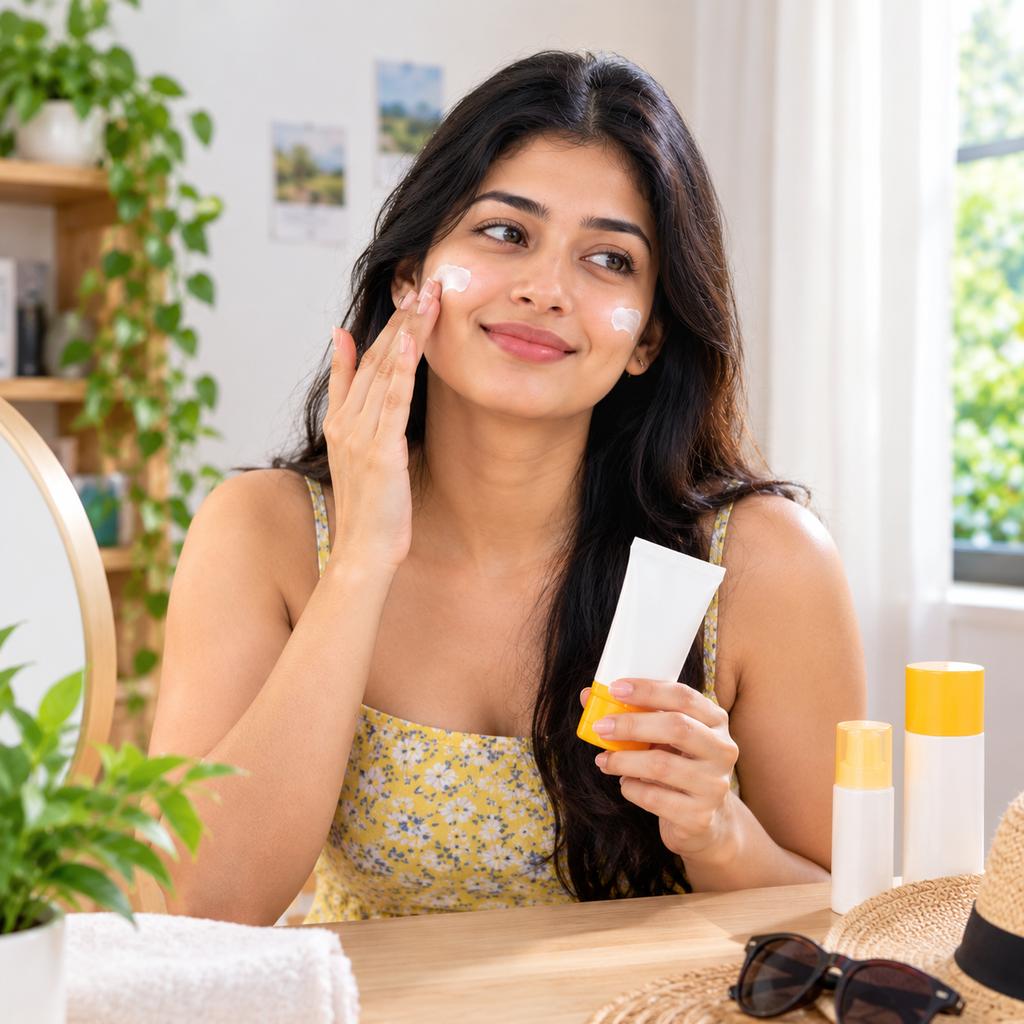
A simple guide for the face and neck: Use about two finger lengths of sunscreen, meaning a line of product along your index and middle fingers. For the entire body, an adult typically needs roughly a shot glass amount (around 30 ml).
Apply to:
- Face, including forehead, nose, cheeks and chin
- Ears
- Neck, front and back
- Hands and forearms
- Any exposed arms, legs and feet
- Lips, using an SPF lip balm
- Scalp parting or thinning hair areas
How to Apply Sunscreen Step by Step
- Cleanse and moisturise your skin.
- Dispense the correct amount. Use the two-finger method for the face.
- Dot it over the face and neck, then spread gently. Avoid rubbing too hard.
- Wait about 10 to 15 minutes before going out or applying makeup, to allow it to settle. Chemical filters especially benefit from this wait.
- Cover often-missed areas: ears, hairline, jawline, back of the neck, tops of the feet.
- Reapply as needed. See below.
When and How to Reapply
Sunscreen wears off through sweat, oil, rubbing and time.
- Reapply every two hours when you are outdoors.
- Reapply after swimming, heavy sweating or towel drying, even if the product is water-resistant.
- If you are indoors away from windows, reapplying is usually not necessary. If you sit near windows or spend time in bright light, consider reapplication if you remain there for long periods.
- Over makeup: Use a sunscreen spray, stick, cushion compact or SPF powder for touch-ups. These help but may not give full protection in a thin layer, so combine them with sensible shade and clothing.
Sunscreen and Makeup: How to Layer
- Apply skincare such as serum and moisturiser.
- Apply sunscreen and let it set.
- Apply primer if you use one.
- Apply foundation, concealer or tint.
- Set with powder if needed.
Makeup with SPF is a bonus, but it usually does not provide enough protection alone since we apply far less foundation than sunscreen.
Beyond Sunscreen: Other Sun Protection Habits
Sunscreen works best as part of a complete plan.
- Seek shade between late morning and mid-afternoon when the sun is strongest.
- Wear protective clothing, such as full sleeves, cotton kurtas, scarves and wide-brimmed hats.
- Use UV-protective sunglasses to shield eyes and the delicate skin around them.
- Use an umbrella, a common and effective Indian tradition.
- Be extra careful near water, sand or snow, which reflect UV rays.
- Do not rely on cloudy weather. UV rays can pass through clouds.
- Avoid deliberately tanning or using tanning beds.
Common Sunscreen Myths
“Dark skin does not need sunscreen.” Melanin offers some natural protection, but not enough to prevent sun damage or skin cancer.
“I only need sunscreen in summer.” UVA rays are present year-round, including winter and monsoon.
“I stay indoors, so I am fine.” UVA can pass through windows, and many people spend time near bright windows or commute.
“A higher SPF means I can stay out all day.” No sunscreen gives total protection, and reapplication is essential.
“Makeup with SPF is enough.” It is rarely applied thickly enough.
“Sunscreen causes vitamin D deficiency.” Normal daily use, combined with diet and brief incidental exposure, generally does not prevent vitamin D production completely. If you are worried about vitamin D levels, speak to your doctor about testing and supplementation.
“Sunscreen clogs pores.” Some heavy formulas can, but there are many non-comedogenic options.
“Natural oils like coconut oil are enough.” They provide minimal protection and should not replace tested sunscreen.
How to Read a Sunscreen Label
Check for:
- Broad spectrum or clear UVA protection information (PA rating)
- SPF 30 or higher
- Water-resistant if you sweat or swim, along with time indicated (for example 40 or 80 minutes)
- Non-comedogenic if you are acne-prone
- Fragrance-free if you have sensitive skin
- Expiry date and the “period after opening” symbol
- Clear ingredient list and manufacturer details
Store sunscreen away from heat and direct sunlight, for example not in a hot car. Replace it if the texture, colour or smell changes, or after the expiry date.
Tips for Wearing Sunscreen Comfortably
- Try samples before buying full sizes.
- Test different textures: gels, fluids, lotions, sticks and sprays.
- Keep a small tube in your bag for touch-ups.
- Make it a habit by placing it next to your toothbrush or moisturiser.
- Involve family members and children, and set a good example.
- Use a separate SPF lip balm.
- If you dislike the feel, try another brand rather than skipping sunscreen.
Sunscreen and Nighttime Care
Sunscreen must be removed at the end of the day.
- Use a gentle cleansing oil, balm or micellar water to dissolve sunscreen and makeup.
- Follow with a mild face wash.
- Apply a suitable moisturiser or night care.
Thorough removal helps prevent clogged pores and irritation.
When to See a Dermatologist
Seek professional advice if you notice:
- A new mole or a mole that changes in size, shape or colour
- A sore that does not heal
- Persistent redness, itching or rashes after using sunscreen
- Worsening pigmentation or melasma
- Severe sunburn with blisters
Regular skin checks are wise, particularly if you have a family history of skin problems.
Frequently Asked Questions
Which is better, SPF 30 or SPF 50?
Both are effective if used properly. SPF 50 offers slightly more protection and can be helpful for long outdoor exposure, but correct amount and reapplication matter more.
Can I use one sunscreen for face and body?
Some products work for both, but facial sunscreens are often formulated to be lighter and non-comedogenic. Use what suits your skin and comfort.
Do I need sunscreen on rainy or cloudy days?
Yes. UV rays penetrate clouds, so daily use is recommended.
How long does a sunscreen bottle last?
If you apply the recommended amount daily, a small tube will finish quickly. Use it before the expiry date and within the period indicated after opening.
Is sunscreen safe to use every day?
For most people, yes. Choose products from reputable brands and consult a doctor if you have allergies or concerns.
Can I apply sunscreen before moisturiser?
The usual order is moisturiser first and sunscreen last, before makeup. Follow product instructions where they differ.
Final Thoughts
Knowing how to choose sunscreen is simpler than it seems. Look for broad-spectrum protection with at least SPF 30 and a high PA rating, pick a texture that suits your skin type, apply enough, wear it daily and reapply when you are outdoors. Combine sunscreen with shade, hats, sunglasses and protective clothing for the best results.
Choose one product this week, and give it a fair trial of a few weeks. Consistent sun protection is one of the most effective, affordable ways to keep your skin healthy, even-toned and youthful for years to come.
Disclaimer: This article is for general information only and is not medical advice. Consult a dermatologist for personalised guidance about your skin.