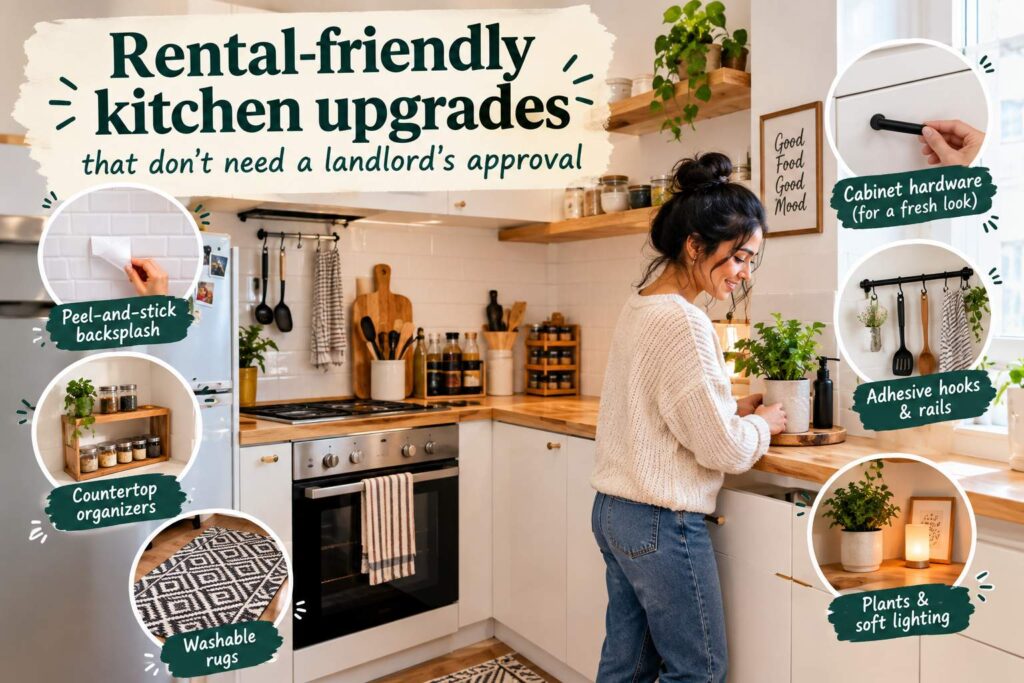
Kitchens are often the room renters feel least able to personalise — fixed cabinetry, landlord-chosen fittings, and a reasonable fear of losing a deposit over anything that looks even slightly permanent. After talking to renters who’d genuinely transformed a rental kitchen without any landlord involvement or permanent change, a clear set of reliably effective, fully reversible upgrades emerged.
Removable materials that survive a full tenancy
Peel-and-stick materials — for backsplashes, cabinet fronts and even flooring — have improved substantially in quality over recent years, and several renters specifically reported using them for multi-year stretches without any adhesive residue or damage on removal, provided the underlying surface was properly cleaned and prepared before application, a step several people specifically flagged as the difference between a clean removal and a genuinely damaging one.
Cabinet fronts specifically saw the most dramatic before-and-after transformations among the renters we spoke with, with removable vinyl wrap applied directly over existing cabinet doors completely changing a kitchen’s visual tone — from dated wood-effect laminate to a clean matte finish, for instance — without ever touching the underlying cabinetry itself. Several renters noted the material held up well even in a heavily used kitchen, provided it was wiped rather than scrubbed during regular cleaning.
Hardware swaps: small change, large visual impact
Swapping cabinet handles and knobs came up as one of the highest-impact, lowest-effort changes across every renter we spoke with, and critically, one that requires no landlord permission at all provided the original hardware is carefully kept and reinstalled at the end of the tenancy. A single afternoon spent replacing dated brass handles with simple matte black or brushed-steel alternatives visibly modernised an entire kitchen for several renters, at a cost considerably lower than almost any other change discussed.
Under-cabinet lighting was the second hardware-adjacent change renters consistently recommended, specifically battery-operated or plug-in LED strip options that require no wiring or electrical work whatsoever. Several renters noted that improved, warmer lighting made as much difference to how a rental kitchen felt in the evening as any visual material change, and unlike hardwired lighting, requires zero landlord involvement to install or remove.
Open shelving and styling, without any drilling
For renters wanting an open-shelf look without drilling into walls — a change that almost universally requires landlord permission — several described using freestanding shelving units positioned against a wall rather than wall-mounted alternatives, achieving a similar visual effect for styled cookware and ceramics without a single new hole in any wall.
Styling existing open counter space with a curated, limited selection of attractive everyday items — a few well-chosen ceramics, a wooden cutting board displayed rather than stored, a small collection of glass jars for dry goods — was the final change renters consistently mentioned, and the one requiring literally no purchase beyond what most kitchens already contain, simply reorganised and displayed with more intention than the default cluttered-counter arrangement most rental kitchens start with.
None of these changes, taken individually or together, put a deposit at any genuine risk according to the renters we spoke with, provided original hardware and fixtures were carefully retained for reinstallation at move-out. Collectively, though, renters consistently described the cumulative effect as transforming how a rental kitchen felt to actually cook and spend time in — proof that meaningful change doesn’t require ownership, just a willingness to work within genuinely reversible materials and methods.
Storage upgrades that leave zero trace
Beyond visual changes, several renters specifically highlighted storage solutions as an underrated category of rental-friendly kitchen upgrade, particularly tension-mounted shelving inserts and stackable organisers that fit inside existing cabinets without any modification to the cabinet itself. These inserts effectively doubled usable storage in several small rental kitchens, addressing what renters described as one of the most common practical frustrations with rented kitchen spaces — insufficient, poorly configured storage that no amount of surface styling can fully compensate for.
Magnetic strips for knife storage, adhesive-mounted spice racks rated for genuine weight, and over-the-cabinet-door organisers were the specific products renters most consistently recommended, each addressing common storage gaps without a single drilled hole or landlord conversation required. Several renters noted that solving storage frustrations often did more for how much they actually enjoyed cooking in a rental kitchen than any purely visual upgrade, even though storage solutions tend to receive less attention in typical rental-decor content.
Documenting the original state before making any changes
A practical piece of advice that came up repeatedly, and one worth taking seriously regardless of how reversible a planned change seems, was thoroughly photographing the kitchen’s original condition — hardware, cabinet finishes, any existing marks or wear — before making any change at all. This documentation, several renters noted, proved valuable specifically in disputes over deposit deductions, providing clear evidence of a kitchen’s condition both before any rental-friendly upgrades were made and again once they were fully removed at the end of a tenancy.
This simple step costs nothing and takes only a few minutes, but renters who’d navigated a deposit dispute specifically credited thorough before-and-after documentation with resolving disagreements quickly and in their favour, reinforcing that the reversibility of rental-friendly changes matters less in practice if it can’t be clearly demonstrated to a landlord or letting agent who wasn’t present throughout the tenancy. A little preparation at move-in, in other words, does as much to protect a deposit as careful material choice does — the two work together rather than either being sufficient alone. Taken together, these changes prove a rental kitchen doesn’t have to feel provisional for the entire length of a tenancy. With a little care and the right materials, a rented kitchen can feel genuinely considered rather than merely borrowed. None of it requires a single conversation with a landlord, which is really the whole point of a genuinely rental-friendly approach. For anyone renting long-term, that independence is often worth more than any single upgrade on its own. Ownership was never really the requirement — intention was. That is, in the end, the most transferable lesson for anyone renting a home they hope to actually enjoy living in.