Most urban Indian bedrooms are somewhere between eighty and a hundred and twenty square feet, which is enough space for a bed and roughly one good decision. The instinct is to buy less furniture and hope the room feels bigger. It usually doesn’t — it just feels emptier and equally cramped, because the problem is rarely the amount of furniture. It’s how the room is using its height, its light and its sightlines.
These small bedroom decor ideas are built for real constraints: rented flats where you can’t knock down walls, budgets that don’t stretch to custom carpentry, and rooms that also have to function as a workspace, a wardrobe and occasionally a guest room.
Start with the floor, not the walls
The single biggest driver of how large a room feels is how much uninterrupted floor you can see. Every visible square foot of floor reads as space; every object sitting on it reads as clutter, even expensive objects.
So before buying anything:
- Get the storage boxes off the floor. Under the bed or on top of the wardrobe — anywhere but the corners.
- Choose furniture with visible legs. A bed or chair raised on slim legs lets the eye travel underneath it. A solid-to-the-floor box bed makes the same footprint feel heavier.
- Remove one thing entirely. There is almost always one piece of furniture — a spare chair, a side table, a drying rack — that exists out of habit. Take it out for a week and see if you miss it.
Use the height you’re ignoring
Indian flats often have nine or ten-foot ceilings, and most people use the bottom six. That top three feet is free storage.
Take wardrobes to the ceiling. A wardrobe that stops at seven feet creates a dust shelf and wastes volume. If you can’t replace it, add a loft cabinet above it, painted the same colour as the wall so it recedes.
Hang curtains high and wide. Mount the rod close to the ceiling — not just above the window frame — and extend it six inches past the window on each side. This is the cheapest trick in interior design and it genuinely works: it draws the eye upward and makes the window look significantly larger.
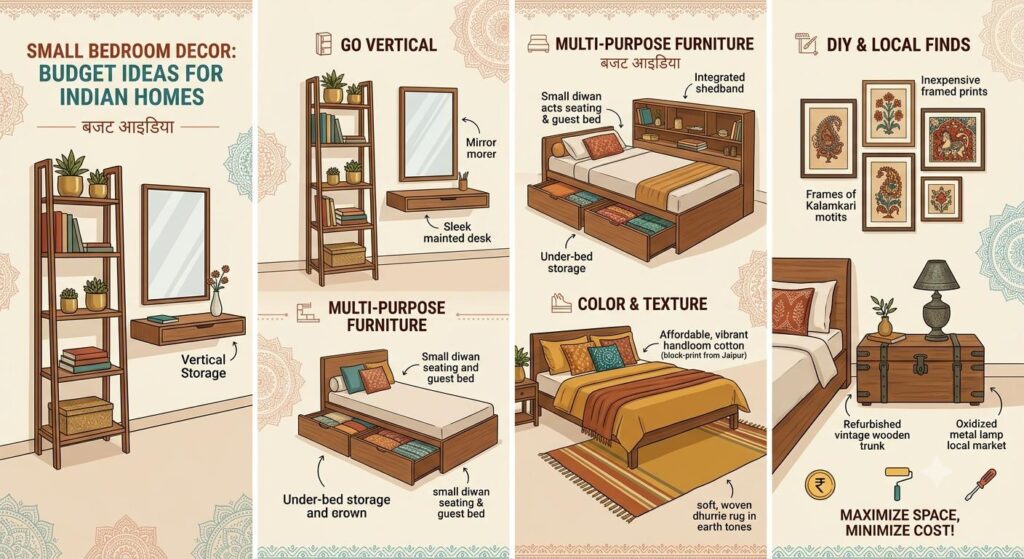
Go vertical with shelves. A narrow tall bookshelf takes less floor than a wide short one and holds more.
Mount the bedside lamp on the wall. A wall sconce or clip light frees the entire surface of a small nightstand.
Paint and colour that make a room breathe
The old advice — paint everything white — isn’t wrong, but it’s incomplete. What actually matters is contrast. A room feels larger when the walls, ceiling and larger furniture sit in a narrow tonal range, because there are fewer visual edges to break the space up.
Some options that work in Indian light, which is warm and strong:
- Warm off-whites — ivory, bone, oatmeal. Pure brilliant white can go grey and cold in north-facing rooms.
- Soft muted tones — sage green, dusty blue, clay pink. These are calmer than they sound and photograph beautifully.
- Painting the ceiling the same colour as the walls. Counterintuitive, but removing the line where wall meets ceiling makes the room feel taller, not shorter.
- One deep accent wall behind the bed. Colour behind you isn’t in your sightline when you’re in the room, so it adds depth without closing the space in.
Whatever you pick, use satin or eggshell finish rather than matte. It reflects more light.
Lighting: the cheapest upgrade with the biggest effect
A single tube light or ceiling fixture in the middle of the ceiling makes every room look like a waiting area. The fix is layering — three or four smaller light sources at different heights instead of one bright one overhead.
A practical setup for a small bedroom:
- Ambient: the ceiling light, ideally on a dimmer or with a warm 2700K–3000K bulb rather than cool white.
- Task: a wall-mounted reading light or a small desk lamp.
- Accent: a floor lamp in a corner, or a strip of warm LED behind the headboard or under a shelf.
Swapping every bulb in the room from cool white to warm white costs a few hundred rupees and changes the mood of the space more than a new bedsheet ever will.
Mirrors, placed properly
Mirrors do make rooms feel bigger, but only when they reflect something worth reflecting. A mirror facing a blank wall just adds another blank wall.
Place a large mirror perpendicular to a window so it catches and bounces daylight into the room. A full-length mirror leaned against a wall also works, and it doubles as your dressing mirror, which removes another object from the room.
Storage that doesn’t look like storage
In a small bedroom, every piece of furniture should be doing at least two jobs.
- A hydraulic storage bed is the highest-value purchase for a small Indian bedroom. It converts dead space into a full season’s worth of quilts, suitcases and boxes.
- A bench or trunk at the foot of the bed holds linen and gives you somewhere to sit while it does.
- Over-the-door hooks and racks cost very little and absorb bags, dupattas and jackets that otherwise end up on the chair.
- Vacuum storage bags for winter bedding, stored under the bed, reclaim genuinely surprising volume.
- A wall-mounted folding desk gives you a work surface that disappears when you’re done.
The principle: if something is visible, it should be either useful or beautiful. Ideally both.
Layout rules for a compact room
Push the bed against a wall if the room is under a hundred square feet — ideally the wall opposite the door, so the room reads as one open path rather than two narrow ones. In slightly larger rooms, centring the bed on its wall with access on both sides feels more generous.
Keep the walking path clear. You need about sixty centimetres of clearance on at least one side of the bed. Protect that.
Don’t push everything against the walls. A common instinct, and it backfires — it creates a ring of furniture and a hollow middle. Floating one piece slightly away from the wall gives the room depth.
Keep sightlines from the door clear. Whatever you see in the first second of entering sets your impression of the size. Make that view the bed and some floor, not a wardrobe door.
Finishing touches on a small budget
- One large artwork instead of a gallery wall. Many small frames fragment a wall; one large piece expands it.
- A rug that’s bigger than you think. A small rug floating in the middle of the floor shrinks a room. It should sit at least partly under the bed.
- Bedding in one or two colours. The bed is sixty percent of the room’s visual weight. Keeping it calm calms everything.
- One or two plants, not eight. A snake plant, pothos or ZZ plant will survive low light and neglect.
- Sheer curtains layered under heavier ones, so you can have privacy and daylight at the same time.
Frequently asked questions
What colour makes a small bedroom look bigger?
Light, warm neutrals — ivory, beige, soft greige — with the ceiling painted in the same tone. Low contrast between surfaces matters more than the specific shade.
Where should the bed go in a small bedroom?
Against the wall opposite the door in very small rooms, leaving one clear walking path. Avoid placing the bed where it blocks the door swing or a window.
How do I add storage without making the room look cluttered?
Use the vertical space and hide storage inside furniture — a hydraulic bed, a storage bench, ceiling-height wardrobes in the same colour as the walls.
Do mirrors really make a room look bigger?
Yes, when positioned to reflect a window or an open sightline. A mirror reflecting a wall or clutter has no effect.
The takeaway
Making a small bedroom feel larger is mostly about editing, not adding. Clear the floor, take the storage upward, warm up the lighting, keep the colour palette narrow, and let one mirror do the heavy lifting. Do those five things and you’ll get more from the room than any amount of new furniture would have given you.