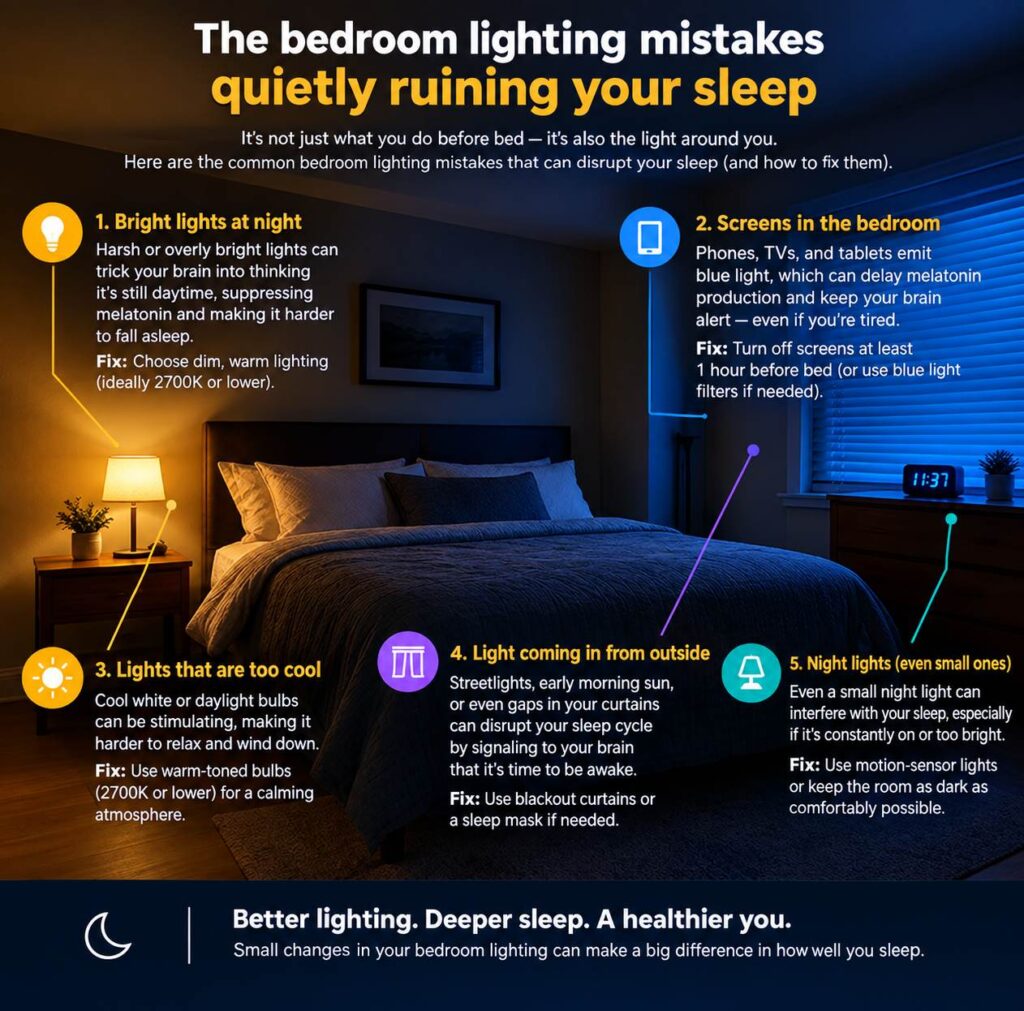
Sleep advice tends to focus heavily on screen time and blue light specifically, but according to several sleep specialists and lighting designers we consulted, a bedroom’s general lighting setup — well beyond just phone and device screens — often plays an equally significant and considerably less discussed role in sleep quality, through mistakes that are common across a large number of bedrooms without most occupants realising the effect.
Overhead lighting used right up until bedtime
The most commonly cited mistake among the specialists consulted was relying on a single bright overhead light for general bedroom use right up until the moment of turning it off to sleep, rather than transitioning to dimmer, lower lighting in the hour or so before intended sleep. Bright overhead light, particularly light with a cooler, bluer colour temperature typical of many standard bulbs, actively suppresses melatonin production, the hormone most directly responsible for signalling to the body that it’s time to prepare for sleep.
The practical fix specialists recommended was straightforward: introducing a secondary, dimmer light source specifically for the pre-bed period — a bedside lamp with a warmer colour temperature, or a dimmer switch on existing overhead lighting — used deliberately in place of bright overhead lighting for the final hour before intended sleep, rather than switching directly from full bright light to complete darkness at the moment of getting into bed.
Streetlight and early-morning light leaking through curtains
External light leaking into a bedroom, whether from streetlights at night or early morning daylight during summer months, was the second major issue specialists flagged, and one that’s often underestimated in terms of its actual effect on sleep quality, particularly for anyone in an urban area with significant nearby streetlighting or for anyone sleeping through a genuinely early sunrise during summer.
Blackout curtains or blinds specifically designed to block light rather than standard curtains that primarily block visibility rather than light itself were the most commonly recommended solution, and several specialists specifically noted that patients who’d struggled with sleep quality for months made noticeable, measurable improvement once genuine blackout coverage was properly installed, having previously assumed their existing curtains were already providing adequate light blocking when they weren’t.
The overlooked issue of light colour temperature
Beyond brightness and external light leakage, the specific colour temperature of bedroom lighting — measured in Kelvin, with lower numbers indicating warmer, more amber-toned light and higher numbers indicating cooler, bluer light — emerged as a more technical but genuinely significant factor according to the lighting designers specifically consulted for this piece, who noted that many standard household bulbs default to a cooler colour temperature more suited to task-focused spaces than a bedroom used primarily for winding down and sleeping.
The recommendation here was to specifically choose warmer-toned bulbs, generally below 3000 Kelvin, for any bedroom lighting used during the evening hours, reserving cooler, brighter light only for specific daytime tasks like reading or getting dressed if a bedroom serves multiple functions throughout the day. Several smart bulb systems now allow this kind of colour temperature adjustment automatically based on time of day, removing the need to manually swap bulbs or remember to adjust settings each evening.
Taken together, these lighting adjustments — dimmer, warmer light in the pre-bed hour, genuine blackout coverage against external light, and generally warmer-toned bulbs for evening bedroom use — represent a relatively low-cost, low-effort set of changes compared to many other sleep interventions commonly recommended, and according to the specialists consulted, one that’s disproportionately underutilised relative to how significant an effect it appears to have on sleep quality for a meaningful number of people who’ve never specifically addressed their bedroom’s lighting setup with these considerations in mind.
Small night lights that do more harm than good
For anyone using a small night light, whether for personal preference or to safely navigate a room during the night, specialists flagged the specific colour and brightness of that light as worth reconsidering carefully. A bright white or blue-toned night light, even a genuinely small and dim one, can be more disruptive to sleep continuity than most people assume, particularly for anyone waking during the night and being exposed to that light for even a brief period before returning to sleep.
The recommended alternative was a genuinely dim, warm-toned or red-toned night light specifically, since red wavelengths have been shown in several studies to have a considerably smaller disruptive effect on melatonin production compared to white or blue-toned light of similar brightness. Several specialists specifically recommended this swap for anyone who wakes during the night for any reason, including parents managing a shared or nearby room with young children, where a night light is often a practical necessity rather than an optional preference that can simply be removed altogether.
Morning light exposure matters just as much as evening dimming
Interestingly, several specialists were quick to note that bedroom lighting advice shouldn’t focus exclusively on the evening — exposure to genuinely bright light shortly after waking plays an equally important role in regulating the same circadian rhythm that evening lighting choices are designed to protect. Opening curtains immediately upon waking, or spending a few minutes near a bright window first thing in the morning, helps reinforce the body’s natural wake signal in a way that complements the evening dimming strategies discussed above, rather than being a separate, unrelated consideration.
For anyone in a bedroom with limited natural morning light, due to orientation or heavy blackout curtains left closed after waking, specialists suggested a bright light lamp specifically designed for this purpose, used briefly after waking, as a practical substitute. This combination of dim, warm evening light and bright morning light exposure, taken together rather than addressing only one half of the daily light cycle, was described by several specialists as the more complete and genuinely effective approach to using a bedroom’s lighting setup to support consistently better sleep.
None of the changes discussed here require a significant renovation or major expense — a couple of warm-toned bulbs, a set of genuine blackout curtains, and a slightly more deliberate approach to when and how bright lighting is used throughout the evening and morning cover the majority of what specialists recommended. For anyone who’s already addressed screen time and other commonly discussed sleep factors without seeing the improvement they’d hoped for, a closer look at exactly how a bedroom is lit, both before sleep and immediately after waking, may be the overlooked piece worth addressing next.