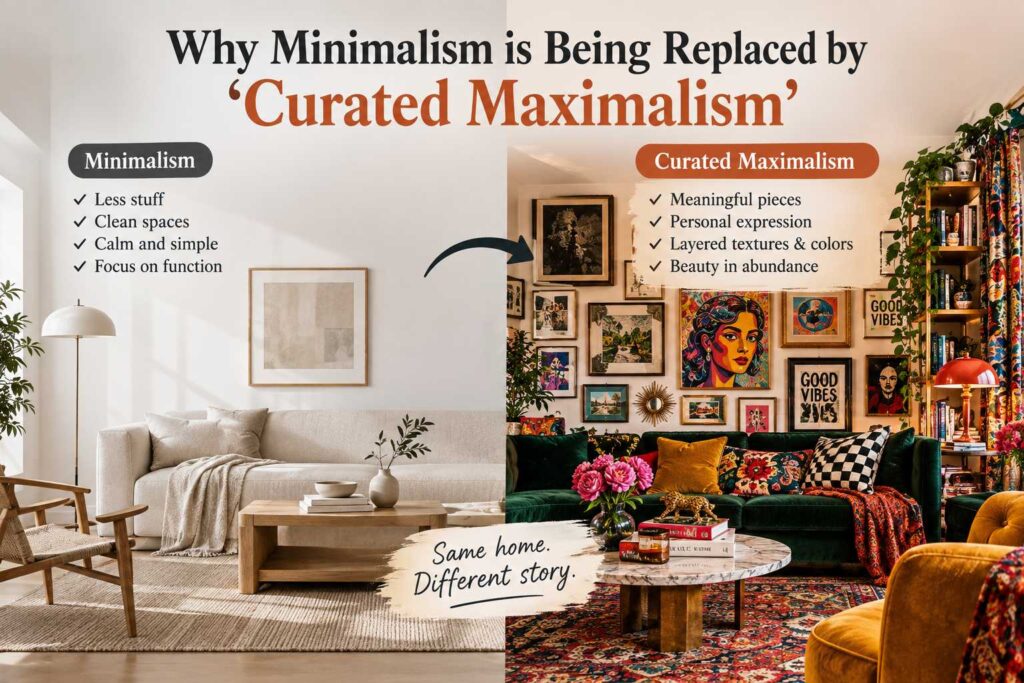
For much of the past decade, minimalism dominated both interior design content and a broader lifestyle aesthetic — empty shelves, monochrome palettes, the deliberate absence of visible personal history in a space. That dominance has been visibly loosening over the past couple of years, replaced by something interior designers are increasingly calling curated maximalism: layered, personal, colour-confident spaces that look assembled over years rather than purchased in a single considered trip.
What curated maximalism actually means
It’s worth distinguishing curated maximalism clearly from simple clutter, a distinction several designers were keen to emphasise. The defining feature isn’t quantity of objects but intentionality behind each one — a shelf of books, ceramics and travel objects that each have a specific story or reason for being there reads as curated maximalism, while the same volume of objects accumulated without much thought reads as simply cluttered. The visual density can look similar; the underlying logic is completely different.
Designers pointed to layering as the key technical skill separating the two — textiles, colours and objects introduced in deliberate layers rather than all at once, each layer given enough visual weight to register individually rather than blending into an undifferentiated mass. This is considerably harder to execute well than the empty-shelf minimalist aesthetic, which is part of why designers describe curated maximalism as requiring more skill and more time to get right, despite looking, on the surface, like it requires less restraint.
Why the pendulum is swinging away from minimalism
Several designers pointed to a straightforward explanation for minimalism’s declining dominance: an aesthetic built around the deliberate absence of personal history has a natural ceiling on how long it can feel genuinely appealing, once its novelty as a reaction against the maximalist decades before it fades. A stark, empty-shelved living room can look genuinely striking in photographs, but designers noted that clients increasingly described their own minimalist spaces as feeling cold or impersonal to actually live in day to day, once the initial aesthetic satisfaction wore off.
There’s also a generational element several designers flagged — younger homeowners and renters, having grown up surrounded by minimalist content online, appear to be actively seeking out visible personality and personal history in their own spaces as a specific reaction against that aesthetic, rather than continuing to default to it simply because it had been the dominant style for most of their design-conscious lives.
How to actually pull off the shift without it looking chaotic
For anyone attempting to move a genuinely minimalist space toward curated maximalism, designers recommended starting with a single anchor colour or material family rather than introducing pattern and colour randomly across a room. A consistent thread — a specific warm wood tone, or a recurring accent colour across otherwise varied objects — gives an eye something to follow across an otherwise visually dense space, preventing the room from reading as chaotic even as the object count increases substantially.
Designers also emphasised that curated maximalism tends to develop over time rather than being achievable in a single shopping trip, and that attempting to buy an entire curated-maximalist look at once often produces a result that looks more like a showroom than a genuinely personal space. The layered, story-driven quality that distinguishes good curated maximalism from mere clutter is, almost by definition, something that has to accumulate gradually through actual living and collecting rather than being purchased wholesale in an afternoon.
Whether curated maximalism eventually swings back toward minimalism again, as design trends have cycled for decades, remains an open question designers were happy to speculate about but reluctant to predict with any confidence. What seems clearer, based on the consistency of what designers are seeing across current client requests, is that the specific stark, empty-shelf version of minimalism that dominated recent years has genuinely lost its cultural momentum, at least for now.
The budget question — is curated maximalism more expensive?
A reasonable assumption might be that a more object-dense aesthetic costs considerably more to achieve than minimalism’s deliberate scarcity, but designers pushed back on this framing directly. Curated maximalism, done well, relies heavily on secondhand, vintage and inherited objects specifically because these tend to carry the visible history and individual character the aesthetic depends on — a charity-shop ceramic with genuine character often serves the look better than a new, mass-produced equivalent, regardless of price.
This means a genuinely curated maximalist space can, in practice, cost considerably less than an equivalent minimalist space built around a smaller number of expensive, considered design pieces, which is often how genuine minimalism is actually achieved despite its visually restrained appearance. Several designers specifically noted this as an underappreciated appeal of the shift for budget-conscious clients, who find sourcing characterful secondhand pieces gradually over time both more affordable and more personally satisfying than a single large purchase of minimalist statement furniture.
Signs the trend has staying power beyond a single season
Several designers pointed to the consistency of client requests across multiple recent projects, rather than a single high-profile influencer moment, as the clearest evidence that curated maximalism represents a genuine, sustained shift rather than a passing aesthetic fad likely to fade within a single season. Requests specifically referencing warmth, personality and layered texture have been remarkably consistent across otherwise very different client demographics and budgets over the past year or more.
That said, designers were careful to note that genuine design trend longevity is difficult to predict with real confidence from inside any single moment, and that the specific visual execution of curated maximalism will likely continue evolving even if the underlying preference for warmth and personal history over stark minimalism proves durable over the coming years. What most designers agreed on, regardless of how the specific aesthetic evolves, is that the appetite for visibly personal, story-driven spaces appears to be a genuine and lasting reaction against the emptier interiors of the past decade, rather than simply another passing style to be replaced by the next trending look. Whatever comes next, they suggested, is unlikely to look like a full return to the stark minimalism it’s currently displacing.