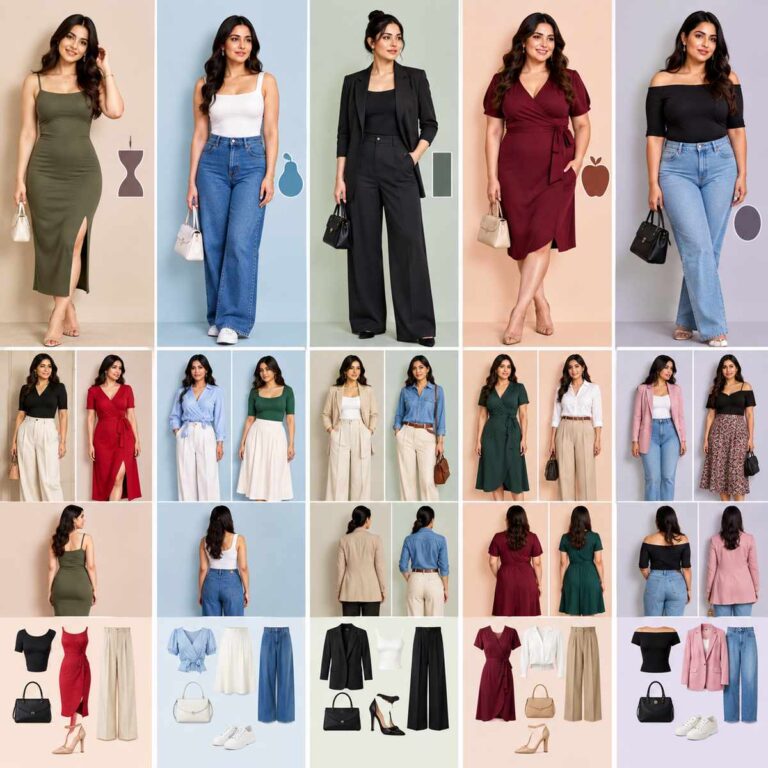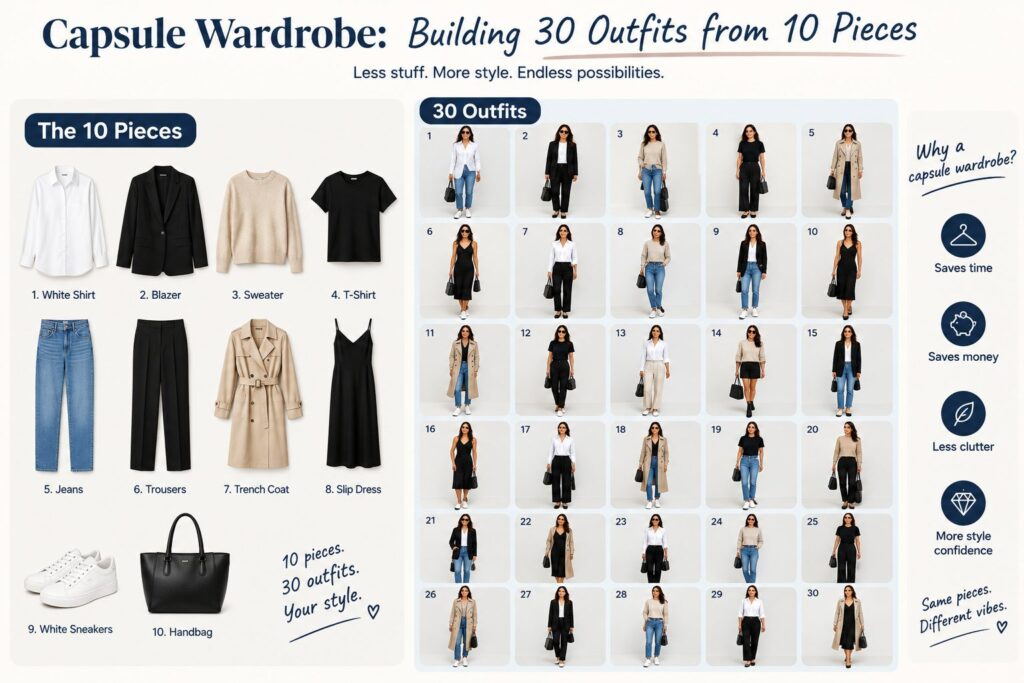
The idea of a capsule wardrobe — a small, deliberately chosen set of clothes that combine into far more outfits than the piece count suggests — has been around for decades, but it’s resurfaced with new urgency as more people try to shop less and wear what they already own more deliberately. The appeal is obvious. The execution, according to the stylists we spoke with, is where most attempts quietly fail.
Why most capsule wardrobe attempts fall apart
The most common mistake, according to every stylist consulted, is building a capsule around pieces that are individually appealing rather than pieces that are collectively compatible. A striking printed blazer might be the first thing pulled off a rack, but if nothing else in the proposed ten pieces shares its colour family or level of formality, it becomes a single-outfit piece rather than a true capsule contributor, quietly defeating the entire exercise.
The second common failure is treating a capsule as a permanent, unchanging set rather than a rotating core. Stylists were consistent on this point: a capsule wardrobe isn’t meant to be the only clothes someone owns forever, but a deliberately restricted set for a season or a specific context — work, travel, a temporary decluttering exercise — that can be swapped out as needs change, without the whole project being abandoned the first time a genuine exception arises.
The 10 pieces that actually deliver the maths
Stylists converged on a fairly consistent list when asked to build a genuine 10-piece capsule: two trousers in different but complementary neutrals, one skirt, two tops in versatile colours, one knit, one blazer, one dress, and two pairs of shoes spanning a casual and a slightly dressier option. The specific items matter less than the underlying logic — every piece needs to plausibly pair with at least four or five of the others, not just one or two standout combinations.
The 30-outfit figure isn’t marketing exaggeration; it’s simple combinatorics once the compatibility rule is actually followed. Ten genuinely interchangeable pieces, mixed and matched across tops, bottoms and layers, mathematically produces dozens of distinct combinations — the real constraint has never been the maths, stylists pointed out, but the discipline of choosing pieces that actually satisfy the compatibility requirement rather than pieces chosen for individual appeal.
Accessories: the part everyone underestimates
A detail stylists emphasised repeatedly, and one rarely mentioned in capsule wardrobe content online, is that accessories do more to multiply a capsule’s apparent variety than any additional clothing piece would. A single dress, worn with three different accessory combinations — a belt and boots, a scarf and flats, statement earrings alone — reads as three distinct outfits to anyone but the wearer, without adding a single garment to the core ten.
This is part of why stylists recommend allocating a meaningful portion of any capsule wardrobe budget to accessories rather than spending it entirely on clothing. A good belt, two or three interchangeable scarves, and a couple of distinct jewellery options do more to combat the visual monotony that derails most capsule wardrobe attempts than a marginal eleventh or twelfth garment would.
Building a genuine capsule wardrobe, in the end, isn’t really about owning fewer clothes for its own sake — it’s about applying enough intention to a small set that the constraint stops feeling like one. The stylists who’d maintained personal capsules for years consistently described the process as counterintuitively liberating rather than restrictive, once the initial work of choosing genuinely compatible pieces was actually done properly.
Testing a capsule before committing fully
Several stylists recommended a low-risk way to test the capsule concept before committing an entire wardrobe budget to it: pack exactly ten pieces for a week-long trip, deliberately leaving everything else at home, and treat the week as a real-world trial of whether the compatibility principle actually holds up in daily use rather than just on paper. Several clients who’d done this reported it was genuinely clarifying — pieces that seemed versatile in theory sometimes proved surprisingly limited once actually worn daily, while other, less obviously exciting pieces turned out to be quietly doing the most work.
This trial approach also surfaces gaps a capsule list might miss on paper — a specific climate consideration, an occasion the initial ten pieces don’t cover well, or simply a colour combination that looked fine as a flat lay but felt wrong in actual daylight. Stylists suggested treating the first attempt at any capsule as a draft to be refined after a genuine trial period, rather than a final, fixed list decided in a single afternoon of planning.
Making it last beyond the first season
Long-term capsule wardrobe users described periodically reassessing the ten core pieces every few months rather than treating the initial selection as permanent — swapping in a seasonally appropriate knit or trouser weight while keeping the same underlying compatibility logic intact. This rolling approach, they noted, is what actually makes a capsule wardrobe sustainable as an ongoing practice rather than a single interesting experiment that quietly gets abandoned once the season changes and the original ten pieces stop making practical sense.
The stylists were unanimous that a capsule wardrobe done properly should never feel like a permanent restriction, but a deliberately chosen starting point that evolves as seasons, needs and personal taste shift — the discipline is in maintaining the underlying compatibility principle each time the specific pieces are refreshed, not in never changing anything at all. Approached this way, several stylists noted, a capsule wardrobe tends to outlast almost every other wardrobe strategy their clients have tried, simply because it’s flexible enough to keep making sense long after the initial novelty of the exercise has worn off. For anyone who’s abandoned a capsule attempt in the past out of boredom, that flexibility, rather than a fixed rulebook, is usually the missing ingredient worth revisiting. Treated as a living system rather than a fixed list, a ten-piece capsule can genuinely serve someone for years, quietly proving that the constraint was never really the point — the compatibility was.