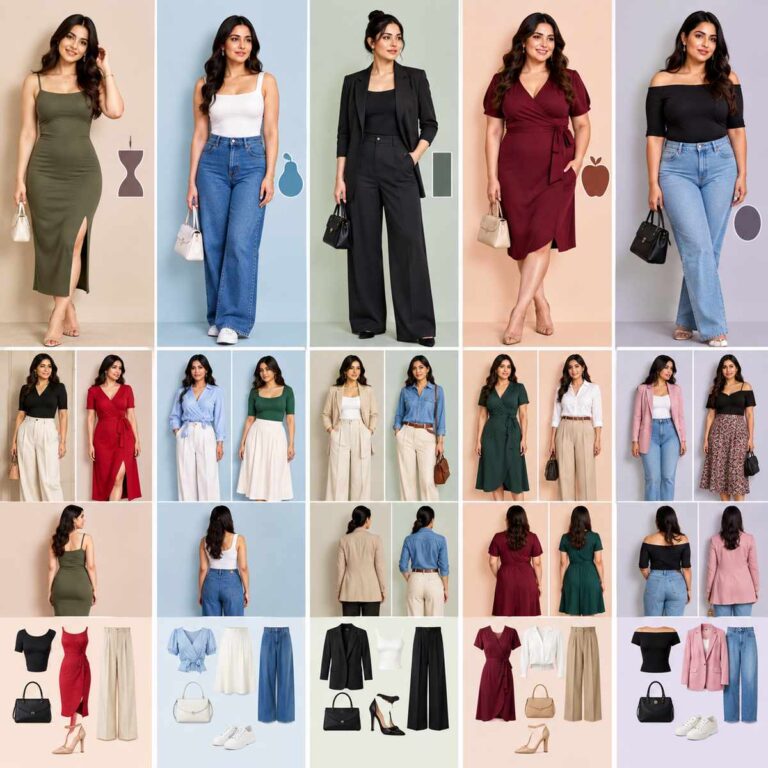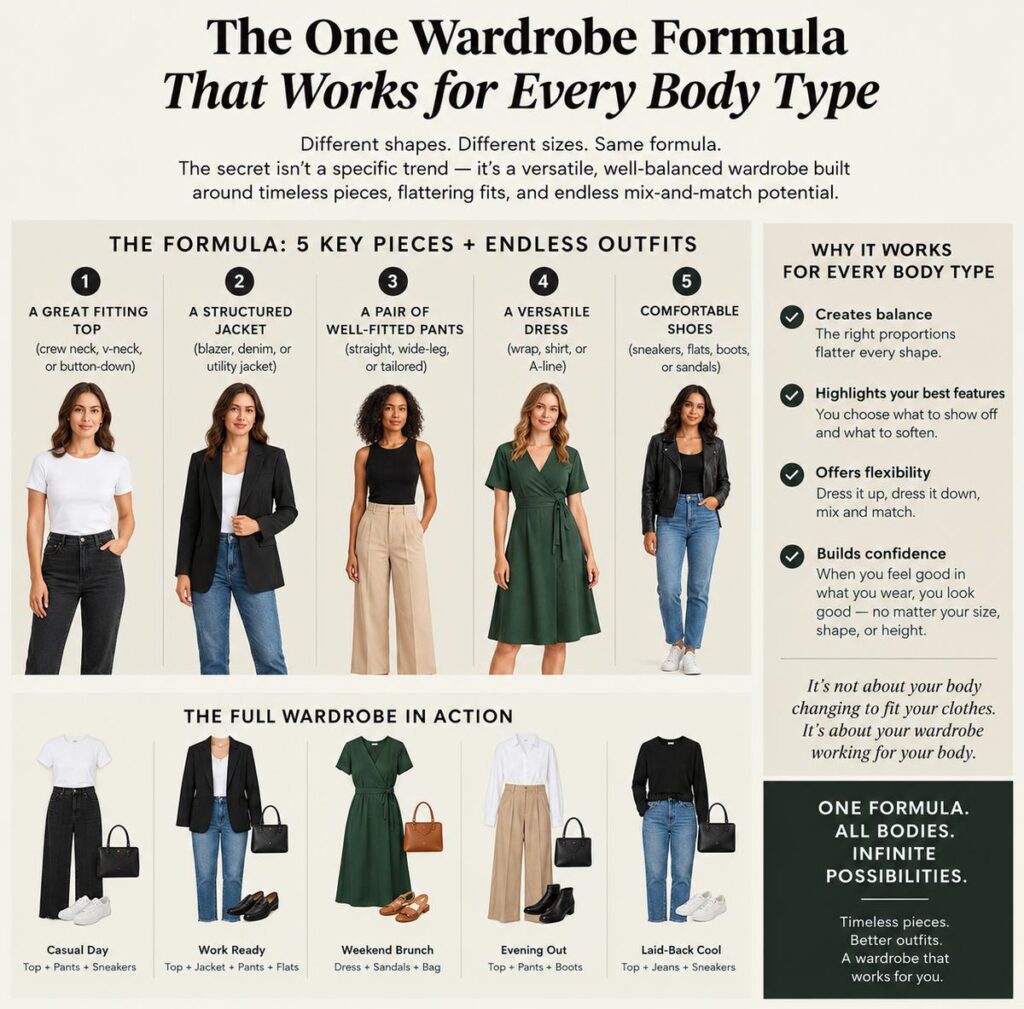
Body-shape charts — apple, pear, hourglass, rectangle — have been a staple of fashion advice for decades, and they’ve also long frustrated stylists who point out how poorly most real bodies fit neatly into four or five rigid categories. After talking to several working stylists about what they actually use instead, a much simpler underlying principle emerged, one that has nothing to do with categorising a body shape at all.
Why shape charts fall apart in practice
The core problem with traditional body-shape charts is that they assume a person’s proportions are fixed and singular, when in reality most people fall somewhere between categories, or shift between them depending on the specific cut, fabric or brand of a garment. A pair of trousers described as ideal for a ‘pear shape’ might fit one person in that category beautifully and completely wrong on another person with an otherwise similar general silhouette, simply because of differences in torso length, height or personal proportion that a broad category can’t account for.
Stylists we spoke to described moving away from these charts years ago in favour of a single, more flexible principle: balance, not shape. Rather than trying to identify a fixed category and then shop exclusively within a prescribed list of ‘flattering’ cuts for that category, the more useful question is simply where an outfit is placing visual volume and definition, and whether that placement feels balanced across the whole silhouette.
The formula, broken down
In practice, this means identifying one area of an outfit to add volume or interest, and consciously keeping the areas around it more fitted or streamlined by contrast. A voluminous sleeve pairs well with a more fitted bottom half; a wide-leg trouser balances well against a more fitted top. The specific body underneath matters far less than whether the overall silhouette has this kind of intentional contrast built into it somewhere.
This is a meaningfully different way of thinking about dressing than the shape-chart approach, because it doesn’t require correctly identifying a fixed category at all — it simply requires looking at any specific outfit and asking whether volume and fit are balanced somewhere across the top and bottom halves, or concentrated all in one place in a way that can read as either overwhelming or shapeless depending on the specific pieces involved.
Applying it without overthinking every outfit
The easiest way to apply this in practice, according to the stylists consulted, is to develop a habit of a quick mental check before leaving the house: is there a fitted moment somewhere in this outfit, and a looser or more voluminous moment somewhere else? If an outfit is voluminous throughout — a loose top with wide trousers, for instance — introducing definition through a belt at the waist achieves the same balancing effect without changing either individual piece.
This single principle also explains why certain combinations that shape-chart advice might specifically warn against for a given body type often work perfectly well in practice, provided the balance principle is respected. A boxy jacket, often flagged as unflattering for fuller figures in traditional shape guides, works well over a more fitted dress or top underneath, because the balance is still present even though the specific pieces involved might not appear on a traditional recommended list.
The broader shift this represents is away from trying to hide or minimise a body toward simply understanding how proportion and volume interact visually, regardless of the specific body wearing a given outfit. It’s a formula that travels well across body types, across different pieces, and across changing personal style over time, which is exactly why the stylists we spoke to have largely abandoned more rigid shape-based advice in favour of this single, flexible principle.
Testing the formula on outfits you already own
One of the more useful exercises stylists recommended was applying this balance principle retroactively to outfits already sitting in a wardrobe, rather than only thinking about it while shopping for something new. Pulling out three or four go-to outfits and specifically identifying where each one places volume and where it places fit tends to reveal a pattern fairly quickly — most people gravitate naturally toward a version of this balance already, even without having consciously named the principle before, and recognising that existing instinct makes it considerably easier to apply deliberately going forward.
For outfits that feel slightly off despite every individual piece being perfectly nice on its own, this same exercise often reveals the actual issue: two voluminous pieces worn together with no fitted counterpoint anywhere, or two fitted pieces that read as slightly severe without any looser element to soften the overall silhouette. In both cases, the fix is rarely to replace either piece, but simply to introduce balance through a third element — a belt, a different shoe, an unbuttoned layer — rather than assuming the outfit itself was a fundamentally poor combination from the start.
Where personal style still matters more than any formula
It’s worth being clear that this balance principle is a starting framework rather than a rigid rule that overrides personal preference or creative styling choices. Several stylists specifically noted clients who deliberately break the balance principle for a particular fashion-forward look, wearing volume throughout an outfit intentionally for dramatic effect, and that this remains a perfectly valid styling choice once someone understands the underlying principle well enough to knowingly depart from it, rather than accidentally landing on an unbalanced silhouette without realising why it feels off.
This distinction — understanding a principle well enough to break it deliberately, versus being unaware of it entirely — is really the difference stylists are describing between someone who dresses with genuine confidence regardless of trend or body type, and someone who feels perpetually uncertain about what will or won’t work for their specific shape. The formula isn’t meant to replace personal taste; it’s meant to give anyone a reliable starting point from which personal taste can then develop with considerably more confidence and considerably less reliance on rigid, one-size-fits-few shape charts.