Indian winter is a strange, uneven thing. Delhi wakes up at seven degrees and hits twenty-two by lunch. Mumbai calls twenty-four degrees “cold.” Bengaluru gets a two-week window of genuinely crisp mornings and then pretends it never happened. So the real challenge isn’t finding warm clothes — it’s building winter outfit ideas for Indian women that survive a fourteen-degree swing between breakfast and evening chai.
The answer is almost always layering, but layering done badly looks like you got dressed in the dark. Below are twelve outfits organised by where you’re actually going, plus the styling logic behind each one so you can rebuild them with whatever is already in your cupboard.
The three-layer rule that makes everything easier
Before the outfits, learn the formula. Every good winter look has three parts:
- The base layer — something thin and close to the body. A cotton camisole, a fitted turtleneck, a slim kurta. This sits against your skin and traps warmth.
- The middle layer — the one doing the actual insulating. A fine-knit sweater, a sweatshirt, a quilted jacket, a thick cotton shirt.
- The outer layer — the piece that shuts out wind and carries the personality. A long coat, a denim jacket, a shawl, an overcoat, a structured blazer.
The trick is that each layer should be removable without ruining the outfit. If pulling off your sweater leaves you in a shapeless vest, the layering has failed. Every layer should look intentional on its own.
Office and workwear looks
1. The grey coat and black trouser column
A long grey overcoat over a black turtleneck and straight-leg black trousers is the closest thing Indian winter has to a uniform. It works because the unbroken dark column from neck to ankle lengthens the frame, and the coat adds structure without bulk. Add loafers or block-heel boots. If your office leans formal, swap the turtleneck for a crisp white shirt and let the collar sit outside the coat.
2. Waistcoat over kurta
One of the most underrated Indian layering pieces. A fitted knit or tweed waistcoat worn over a straight cotton kurta with cigarette pants gives you warmth exactly where you need it — the torso — while keeping your arms free for typing, driving and general functioning. It also photographs beautifully, which matters more than we admit.
3. Blazer, sweatshirt, straight jeans
The high-low combination. An oversized blazer thrown over a plain sweatshirt with dark straight-leg jeans reads as deliberate rather than lazy, as long as the blazer is structured and the sweatshirt is free of loud graphics. Keep the colour palette to two tones — camel and cream, navy and grey, black and white.
College and everyday casual
4. Oversized sweater, bike shorts or leggings, chunky sneakers
Comfortable, warm, and endlessly repeatable. The rule that saves this look: if the top is oversized, the bottom must be fitted. Balance is the entire point.
5. Denim jacket over a kurta
Indo-western that actually works. A mid-wash denim jacket over a printed cotton kurta with white sneakers is the outfit equivalent of comfort food. It handles a ten-degree morning and a twenty-degree afternoon equally well because the jacket comes off in two seconds.
6. The sweater-vest and shirt combination
A knitted vest over a full-sleeve shirt, with the shirt cuffs and collar showing, gives a preppy, put-together look for almost no effort. Pair with wide-leg trousers or a pleated skirt with opaque tights.
7. Hoodie under a long coat
Yes, this works. The contrast between casual fleece and a tailored coat is the whole appeal. Keep the hood outside the coat collar and the rest of the outfit simple.
Weekend, travel and hill-station looks
8. The puffer and pleated skirt
A cropped puffer jacket over a midi pleated skirt with boots and thick tights sounds unlikely and looks excellent. The puffer’s volume up top plays against the skirt’s movement below. Ideal for Shimla, Manali, Mussoorie — anywhere you’ll be outdoors for hours.
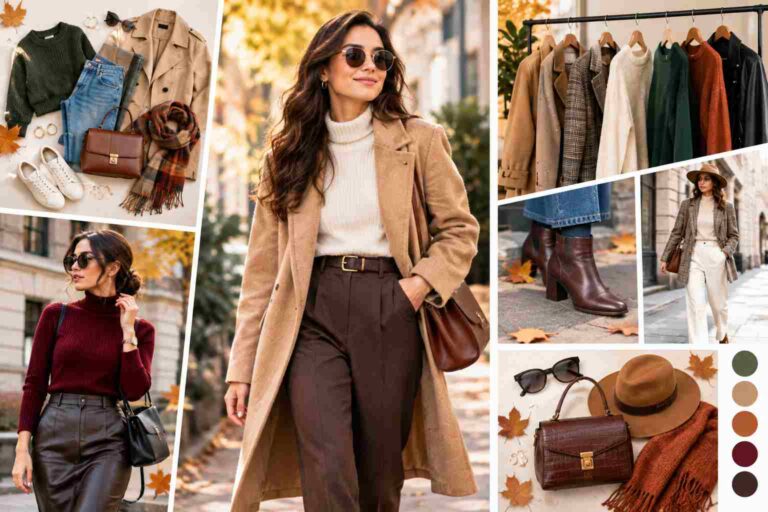
9. Full monochrome in a warm neutral
Camel on camel, chocolate on chocolate, cream on cream. Monochrome dressing is the fastest way to look expensive, because the eye reads one continuous shape instead of competing pieces. Vary the textures — a wool coat, a knit scarf, corduroy trousers — so it doesn’t go flat.
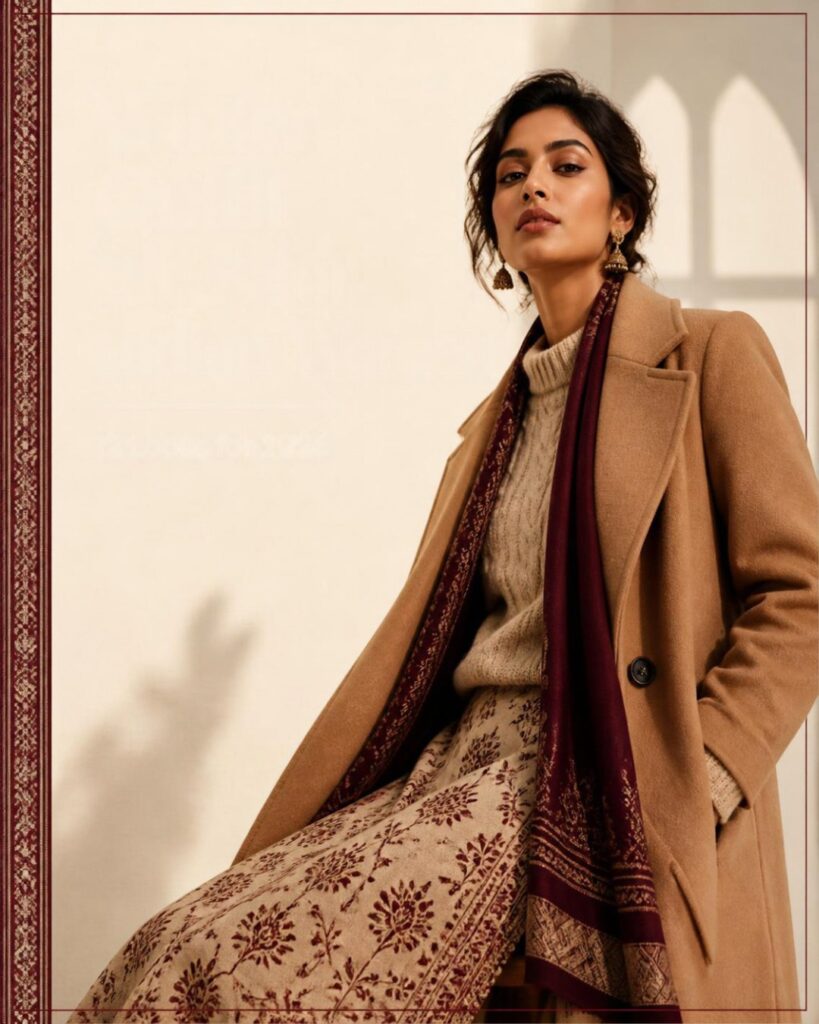
10. Shawl as outerwear
A large pashmina or wool shawl draped over one shoulder and pinned, worn over jeans and a sweater, is warmer than most jackets and infinitely more elegant. This is the look your grandmother had right all along.
Wedding season and evening events
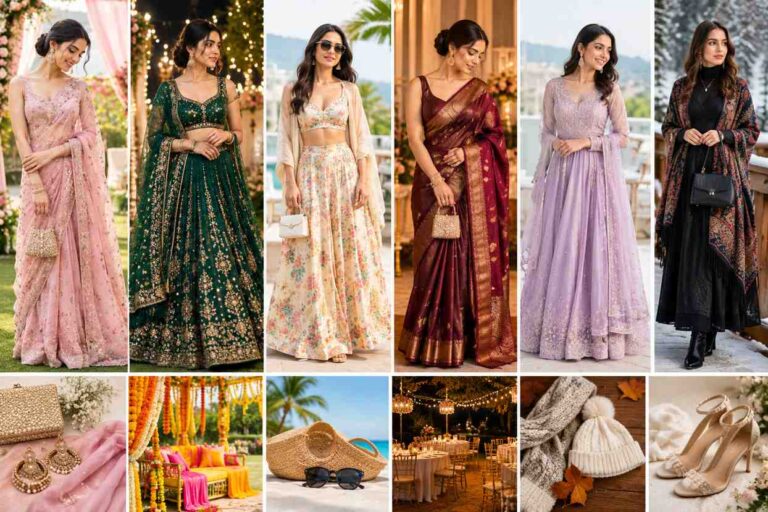
11. Velvet with everything
Velvet is the winter wedding fabric for a reason — it holds heat, catches light, and needs almost no embellishment to look formal. A velvet kurta with a plain silk dupatta, or a velvet blouse with a simple silk saree, does the heavy lifting on its own.
12. The embroidered jacket over a saree or lehenga
Instead of shivering through a December sangeet, wear a structured embroidered jacket over your outfit. Long jackets over lehengas and short bolero-style jackets over sarees both work. Choose one that echoes a colour already in the outfit rather than introducing a new one.
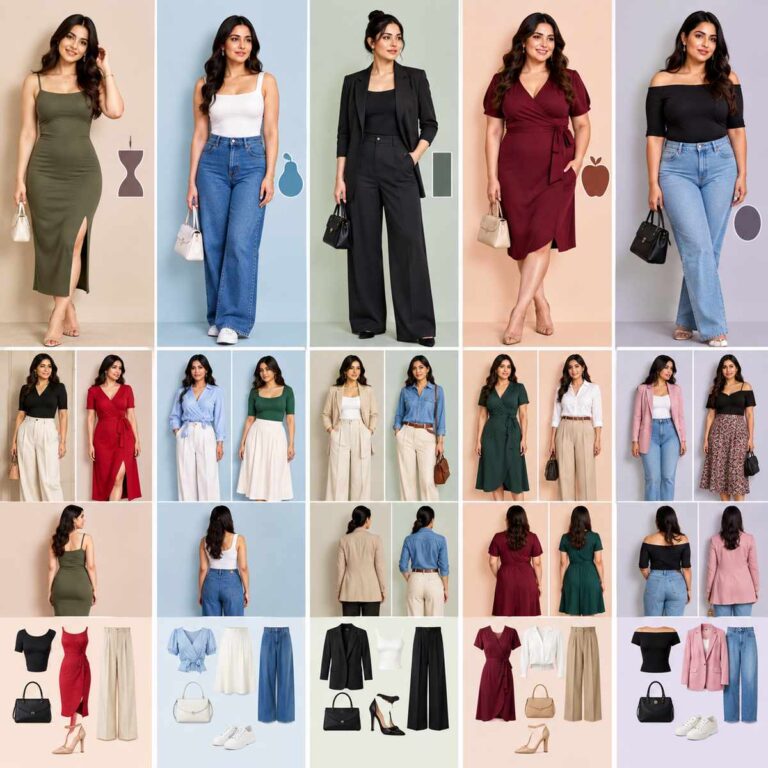
Styling notes by body type
Layering adds visual volume, so the placement matters more in winter than any other season.
- If you carry weight around the midsection: choose open-front layers — long cardigans, unbuttoned coats, waterfall jackets. The vertical line breaks up the width.
- If you’re petite: avoid coats that end mid-calf. Look for jackets ending at the hip or just above the knee, and keep the outfit underneath in one colour family.
- If you have broader shoulders: skip heavy shoulder padding and puffed sleeves. V-necks and open collars help enormously.
- If you’re tall: you can carry full-length coats and oversized knits that overwhelm most people. Use that.
Five winter accessories worth the money
- A neutral wool scarf in beige, grey or black — it will go with eighty percent of your wardrobe.
- Ankle boots with a block heel — stable on Indian pavements, dressy enough for work.
- Opaque tights in 80–120 denier — they turn every summer dress into a winter dress.
- A structured tote that holds the layer you peeled off at noon.
- One statement coat in a colour you love, because it will appear in every photograph you take for four months.
Common winter styling mistakes
Wearing all your warmth on the outside. A single thick jacket over a thin t-shirt is less warm than three thin layers, and far less flexible.
Ignoring fabric. Acrylic looks like wool and behaves like plastic. It doesn’t breathe, so you overheat indoors and freeze outdoors. Wool, cotton blends and cashmere are worth the higher cost per wear.
Forgetting the neck and ankles. Most heat escapes at the extremities. A scarf and proper socks do more than another sweater.
Buying trend pieces in January. The season is nearly over. Buy your winter staples in October, and your trend pieces in the end-of-season sale for next year.
Frequently asked questions
What is the best winter outfit for Indian office wear?
A long neutral coat over a turtleneck and tailored trousers is the most reliable combination. It’s warm on the commute, easy to shed indoors, and appropriate in almost every Indian workplace.
How do I stay warm without looking bulky?
Use thin thermal or fine-knit base layers instead of thick sweaters, and let one structured outer layer provide the shape. Bulk comes from too many mid-weight layers, not from too many layers.
Can I wear sarees in winter?
Absolutely — choose heavier fabrics like velvet, silk, tussar or wool-blend, wear a full-sleeve or high-neck blouse, and add a shawl or short jacket for outdoor events.
What colours work best for Indian winter?
Warm neutrals — camel, chocolate, olive, oatmeal — plus deep jewel tones like burgundy, forest green and navy. These photograph well in low winter light and mix easily with each other.
The takeaway
Good winter dressing in India isn’t about owning more clothes. It’s about owning layers that work independently, choosing fabrics that breathe, and building a small rotation of combinations you trust. Pick three of the outfits above, check whether you already own the pieces, and you’ll find you’re most of the way there.